倔
Character Story & Explanation
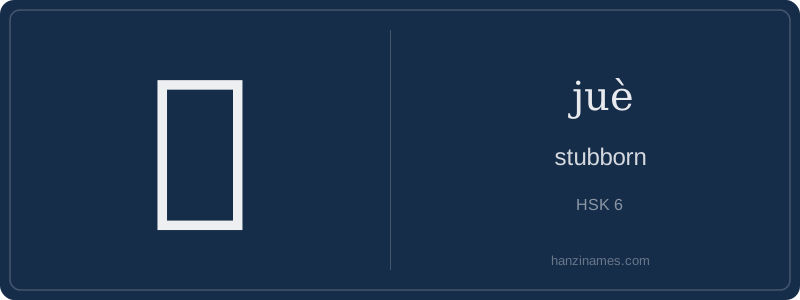
In contemporary Mandarin, 倔 is most commonly used in compound terms like 倔强 (juéjiàng) and 倔脾气 (juè píqì), both widely documented in modern literature and media. Lu Xun’s 1925 essay ‘On Looking Down Upon the Common People’ uses 倔强 to characterize the unbroken spirit of oppressed laborers—a usage echoed in official CCP discourse praising ‘the stubborn resilience of the working class’. It appears frequently in psychological assessments and parenting guides to denote inflexible, oppositional behavioral patterns.
The character is not pictographic; its structure is semantic-phonetic (形声字). The left 亻 (person) signals human-related meaning; the right part, originally derived from 桀 (jié, ‘tyrant’), serves phonetically for juè and historically connotes defiance. No oracle bone or bronze script forms survive—its earliest attestation is in Han dynasty bamboo slips (c. 2nd c. BCE), already in its modern shape and sense.
As an archaeologist brushing dust from a Tang-dynasty stele, I found 倔 etched not as a philosophical ideal—but as a diagnostic label. Inscriptions in medical manuscripts from Dunhuang (c. 9th–10th c.) use 倔 to describe patients exhibiting 'unyielding qi'—a stubborn bodily resistance to herbal treatment or acupuncture, later codified in Ming-era texts like Compendium of Materia Medica as a constitutional trait affecting prognosis.
This character’s ten strokes conceal a quiet rebellion: the 亻 (person) radical anchors it in human behavior, while the ‘jué’ phonetic component (from 桀, an infamous tyrant in Shang oracle-bone records) subtly evokes moral obstinacy—not mere moodiness, but a will that defies hierarchy, ritual, or even healing. Early Buddhist sutras translated into Chinese (e.g., Kumārajīva’s 5th-c. versions) borrow 倔 to render Sanskrit *dṛḍha* (‘firm’) with ethical ambiguity—praise for steadfast practice, censure for doctrinal rigidity.
Excavations at Xi’an’s Sui-Tang capital site uncovered clay tablets where local magistrates recorded juvenile delinquents as ‘倔子’—not ‘rebellious youth’ in the modern sense, but youths whose refusal to kneel during ancestral rites signaled dangerous spiritual nonconformity. This historical weight explains why 倔 remains absent from children’s textbooks until HSK 6: it carries lexical gravity, reserved for adults analyzing temperament, politics, or pathology—not casual description.
Example Sentences
Common Compounds
Similar Characters — Don't Mix These Up
Your First Step into Chinese Culture: Get a Chinese Name
Every journey into Chinese begins with a name. Use our free Chinese name generator to create a meaningful, personalized Chinese name that fits you perfectly.
Get My Chinese Name →