倘
Character Story & Explanation
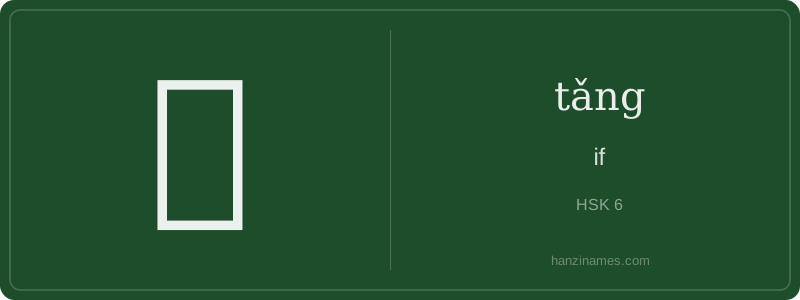
倘 is rarely used in spoken Mandarin but remains vital in formal writing. It appears frequently in official documents (e.g., government policy drafts), literary criticism, and legal clauses where precise, non-colloquial conditionals are required. A well-documented phrase is 倘若 (tǎngruò), meaning 'if' or 'in case', widely used in news editorials and academic papers. Historical usage traces back to Tang and Song dynasty prose, where it introduced hypothetical arguments in philosophical treatises—e.g., Han Yu’s essays employed 倘 to pose ethical dilemmas with rhetorical finesse.
The character combines 亻 (person radical) and 尚 (shàng, 'still, yet, above'), indicating a person holding something elevated—figuratively, a mind entertaining a higher-order possibility. Though not a pictograph, this structure reflects its function: introducing a supposition that transcends immediate reality. Today, Chinese writers choose 倘 deliberately to signal stylistic sophistication and intellectual caution.
倘 (tǎng) is a formal, literary conjunction meaning 'if', 'supposing that', or 'in case'. Unlike the colloquial 'rúguǒ' (如果) or 'yào shì' (要是), 倘 appears predominantly in written Chinese—especially in classical texts, legal documents, academic essays, and formal speeches. Its tone is cautious and hypothetical, often introducing a conditional clause with rhetorical weight or polite deference. It conveys intellectual nuance rather than everyday pragmatism, making it a hallmark of educated diction.
This character reflects a deeply rooted Chinese rhetorical tradition valuing indirectness and contingency. In classical philosophy and policy discourse, 倘 signals thoughtful qualification—not doubt, but measured openness to alternative scenarios. Its usage mirrors Confucian ideals of humility before uncertainty: one does not assert absolutes but explores possibilities with restraint. This contrasts sharply with Western logical 'if-then' structures that prioritize binary causality over contextual sensitivity.
Western equivalents like 'were it the case that...' (archaic English), 'supposing that...', or German 'wäre es doch so, dass...' share 倘’s formality and hypothetical gravity—but lack its cultural resonance with scholarly decorum and textual economy. While English conditionals often rely on verb mood (subjunctive), 倘 functions syntactically as a standalone adverbial particle, requiring no auxiliary verbs. This compactness embodies the classical Chinese preference for semantic density over grammatical explicitness—a feature admired by translators and linguists alike.
Example Sentences
Common Compounds
Similar Characters — Don't Mix These Up
Your First Step into Chinese Culture: Get a Chinese Name
Every journey into Chinese begins with a name. Use our free Chinese name generator to create a meaningful, personalized Chinese name that fits you perfectly.
Get My Chinese Name →