倦
Character Story & Explanation
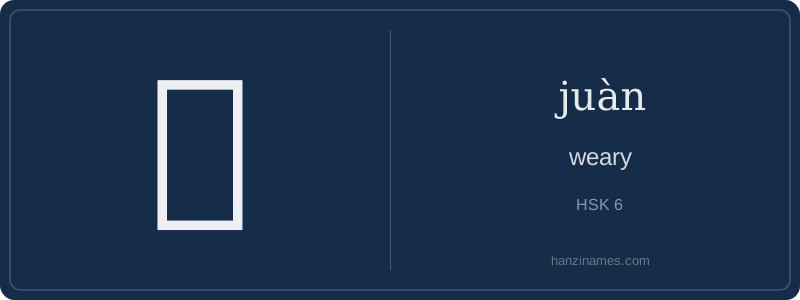
倦 is most famously embedded in the classical idiom 诲人不倦 (huì rén bù juàn), meaning 'to teach others tirelessly'—a cornerstone phrase in Chinese education discourse, cited in official MOE documents and teacher certification standards. It also appears in modern psychological and medical contexts: '职业倦怠' (zhíyè juàndài, 'occupational burnout') is a clinically recognized term used in China’s 2022 National Mental Health White Paper. Government health campaigns employ 倦 to describe chronic fatigue syndrome symptoms.
The character evolved from seal script where 亻+卷 clearly combined semantic (person) and phonetic (卷, pronounced juǎn then, close to juàn) elements. No oracle bone form survives—its earliest attestation is in Warring States bamboo slips (c. 4th century BCE), confirming its origin as a late Zhou innovation for abstract mental states, not a natural object depiction.
Our detective begins at the crime scene: the character 倦, first documented in seal script (c. 3rd century BCE) and standardized in clerical script during the Han dynasty. Its left side 亻—'person radical'—immediately signals human experience. The right component 卷 (juǎn) originally meant 'to roll up' or 'scroll', but here functions phonetically while subtly reinforcing meaning: just as a scroll unspools and then tires of motion, so does the human spirit under prolonged exertion.
Zooming in on historical usage, 倦 appears early in Confucian texts like the *Analects* (e.g., 7.19: '学而不厌,诲人不倦' — 'Study without satiety; teach others without weariness'), establishing its moral weight: not mere physical fatigue, but the ethical stamina required for self-cultivation and service. This elevated register persists—倦 rarely describes sleepy toddlers, but rather the dignified exhaustion of scholars, teachers, or officials fulfilling duty.
The character’s 10-stroke composition is tightly balanced: two strokes for the person radical, eight for 卷. Its stroke order follows strict conventions—starting with the left ‘person’ stroke, then the top horizontal of 卷, ensuring visual harmony and legibility in both print and handwriting. Unlike pictographic characters, 倦 is phono-semantic: no sun, moon, or ox—just elegant structural logic encoding embodied human limits.
Example Sentences
Common Compounds
Similar Characters — Don't Mix These Up
Your First Step into Chinese Culture: Get a Chinese Name
Every journey into Chinese begins with a name. Use our free Chinese name generator to create a meaningful, personalized Chinese name that fits you perfectly.
Get My Chinese Name →