伦
Character Story & Explanation
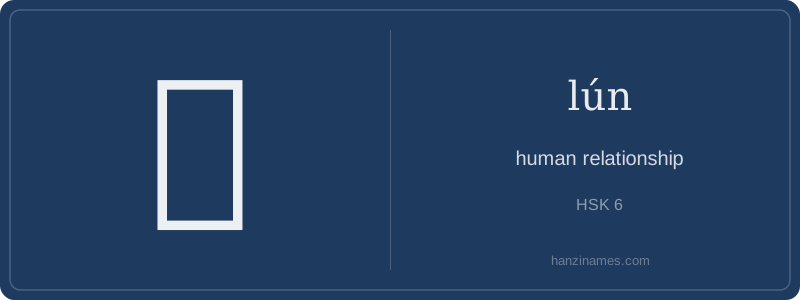
伦 appears frequently in formal and academic contexts—especially in ethics (伦理, lún lǐ), medical ethics (医学伦理, yī xué lún lǐ), and business conduct (商业伦理, shāng yè lún lǐ). A well-documented usage is in the classical text Mencius (3rd c. BCE), where 五伦 (wǔ lún, 'Five Relationships') is codified as foundational to moral order. Modern media and policy documents regularly invoke 伦理 to debate AI governance, gene editing, and elder care standards.
The character 伦 evolved from seal script (c. 220 BCE), combining 亻 (person radical) and 仑 (lún, originally meaning 'ordered stack', later phonetic). Its earliest attested use is in bronze inscriptions of the Warring States period, denoting 'proper human order'. No oracle bone form survives; its structure reflects semantic-phonetic composition—not pictography.
The Chinese character 伦 (lún) fundamentally denotes 'human relationships'—not merely interpersonal ties, but the ethical, hierarchical, and reciprocal bonds that structure social life in Confucian thought. Unlike Western individualism, which often prioritizes personal autonomy, 伦 emphasizes relational duty: parent-child, ruler-subject, husband-wife, elder-younger, and friend-friend. These 'Five Relationships' (五伦, wǔ lún) form a moral framework where identity and virtue emerge through role-fulfillment, not abstract rights.
In contrast to Western equivalents like 'relationship' (neutral, transactional) or 'ethics' (abstract principle), 伦 carries normative weight—it implies proper conduct, mutual obligation, and social harmony. While Aristotle’s 'philia' or Kant’s 'duty' touch on similar ideas, 伦 is inseparable from concrete roles and ritualized behavior (li), making it more systemic and less universalist than Western moral categories.
This concept remains deeply embedded in modern Chinese society: workplace hierarchies, family care expectations, and even digital etiquette reflect 伦-based logic. Though secularized today, its influence persists in phrases like 伦理 (lún lǐ, 'ethics') and 道德伦理 (dào dé lún lǐ, 'moral ethics'). Understanding 伦 is essential for grasping why Chinese discourse often frames justice, responsibility, or conflict resolution through relational accountability rather than individual rights alone.
Example Sentences
Common Compounds
Similar Characters — Don't Mix These Up
Your First Step into Chinese Culture: Get a Chinese Name
Every journey into Chinese begins with a name. Use our free Chinese name generator to create a meaningful, personalized Chinese name that fits you perfectly.
Get My Chinese Name →