偏
Character Story & Explanation
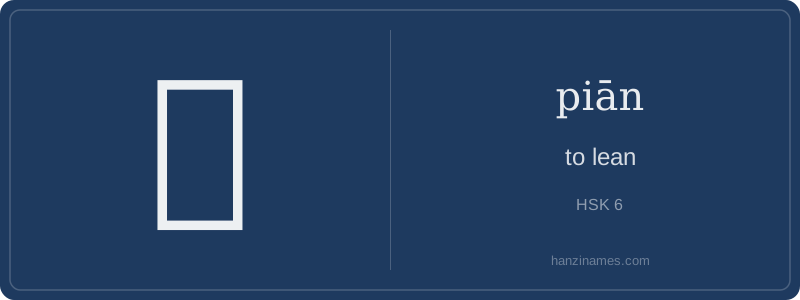
偏 is widely used in modern Mandarin to express subjective preference (e.g., 偏爱, piān’ài — 'to favor disproportionately') and cognitive bias (偏见, piānjiàn — 'prejudice'), both central to public discourse, psychology textbooks, and media literacy campaigns in China. It appears in the HSK 6 vocabulary list and frequently in official documents addressing fairness in education and employment. A well-known idiom is 偏听偏信 (piāntīng piānxìn), meaning 'to accept one-sided information uncritically'—cited in classical texts like the *Tongjian Gangmu* and still invoked in contemporary anti-misinformation initiatives.
The character’s form combines 亻 (person radical) and 扁 (biǎn, 'flat' or 'flattened'), originally indicating a person standing askew or off-center. While its earliest attestation is in seal script (c. 3rd century BCE), the semantic link to 'leaning' solidified during the Han dynasty, reflecting a shift from physical posture to metaphorical inclination—mirroring how speakers today might say 我偏偏要这么做 (wǒ piānpiān yào zhème zuò) — 'I *insist* on doing it this way' — highlighting willful, even defiant, leaning against expectation.
At its core, 偏 (piān) embodies the Chinese philosophical sensitivity to imbalance—not as failure, but as a natural, dynamic condition requiring awareness and adjustment. Unlike Western binaries that often seek absolute centrality or correctness, Chinese thought treats 'leaning' as an observable fact of human perception, social positioning, and cosmic flux—echoing Daoist notions of yin-yang interplay, where deviation signals not error but relational context.
This character reflects Confucian ethics too: 'leaning' toward bias (偏见, piānjiàn) is warned against, yet 'leaning' toward virtue (如偏爱, rú piān’ài) is acknowledged as human and even instructive. The moral task isn’t eliminating inclination, but cultivating discernment—knowing *when* and *how much* to lean, and when to recenter through ritual (lǐ), reflection, or dialogue.
Culturally, 偏 reveals how language encodes humility before complexity. To say 'I lean toward this view' (我偏向…, wǒ piānxiàng…) subtly admits subjectivity without defensiveness—a linguistic gesture of intellectual modesty. In education, medicine, or governance, recognizing one’s 偏 helps avoid dogma; in poetry or calligraphy, it celebrates asymmetry as aesthetic truth. Thus, 偏 is not deviation from perfection—but an invitation to engage with reality as it sways, breathes, and bends.
Example Sentences
Common Compounds
Similar Characters — Don't Mix These Up
Your First Step into Chinese Culture: Get a Chinese Name
Every journey into Chinese begins with a name. Use our free Chinese name generator to create a meaningful, personalized Chinese name that fits you perfectly.
Get My Chinese Name →