逼
Character Story & Explanation
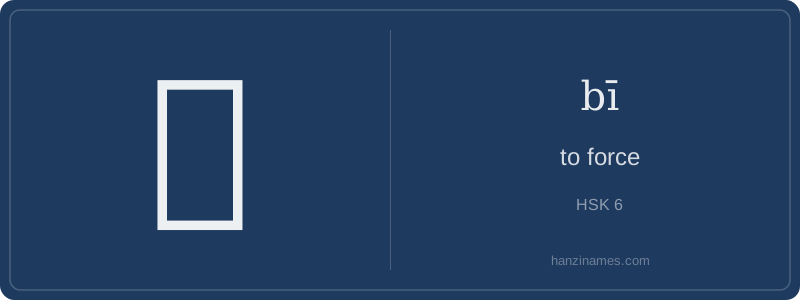
逼 is widely used in modern Chinese across media, workplace language, and internet slang. Common phrases include 走投无路 (zǒu tóu wú lù, ‘no way out’)—often paired with 逼 in expressions like ‘被逼到绝境’ (bèi bī dào juéjìng, ‘forced to the brink’). The idiom 逼上梁山 (bī shàng Liángshān), from the classic novel *Water Margin*, refers to being driven to rebellion by injustice—a historically documented motif reflecting Ming-Qing era peasant uprisings.
Graphically, 逼 is a phono-semantic compound: the left component 厂 (hǎn, ‘cliff/shelter’) hints at confinement, while the right 乚 (yǐn) is a simplified form of 隹 (zhuī, ‘short-tailed bird’), now serving mainly as phonetic support. Though its earliest seal script forms (c. 3rd c. BCE) show a person under a cliff, modern usage focuses on psychological pressure—not physical enclosure.
The Chinese character 逼 (bī) conveys a strong sense of compulsion—often urgent, external, and psychologically or socially coercive. Unlike English ‘ask’ or ‘request’, 逼 implies pressure that leaves little room for refusal: think deadlines imposed by authority, peer pressure in group settings, or societal expectations that ‘force’ conformity. Its radical 辶 (chuò), meaning ‘walk’ or ‘movement’, suggests an advancing, inescapable force—like someone closing in.
In Western contexts, equivalents like ‘coerce’, ‘compel’, or ‘bully’ carry legal or moral weight, often implying wrongdoing. But 逼 is more neutral and ubiquitous in Chinese—used even in self-deprecating humor (e.g., ‘被老板逼着加班’ — ‘forced by the boss to work overtime’) without automatic condemnation. It reflects a cultural acknowledgment of structural pressure as ordinary, not inherently immoral.
This nuance distinguishes it from milder synonyms like 要求 (yāoqiú, ‘to request’) or stronger ones like 胁迫 (xiépò, ‘to threaten’). 逼 sits in the pragmatic middle: not illegal, not optional, but socially sanctioned pressure—akin to ‘being backed into a corner’ or ‘having no choice but to comply’. Its frequency in spoken Mandarin underscores how deeply embedded relational obligation and hierarchical expectation are in daily communication.
Example Sentences
Common Compounds
Similar Characters — Don't Mix These Up
Your First Step into Chinese Culture: Get a Chinese Name
Every journey into Chinese begins with a name. Use our free Chinese name generator to create a meaningful, personalized Chinese name that fits you perfectly.
Get My Chinese Name →