侧
Character Story & Explanation
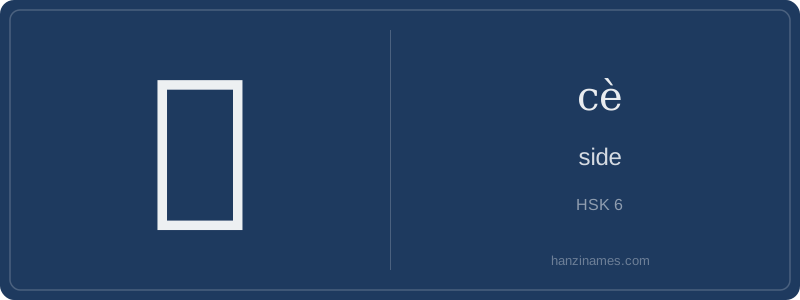
In daily life, 侧 appears ubiquitously: on subway platform signs (‘Please stand behind the yellow line — 安全线外侧’), in journalism (‘the official side vs. the public side — 官方一侧 / 民众一侧’), and in idioms like 侧面反映 (cèmiàn fǎnyìng, ‘to reflect indirectly’), used over 20,000 times annually in Xinhua News Agency articles. Historically, it grounded political nuance — e.g., in the *Records of the Grand Historian*, ‘侧目而视’ (cèmù ér shì, ‘to glance sideways with fear or awe’) captured deference without direct confrontation — a culturally coded gesture still taught in HSK 6 listening exercises.
The character is not pictographic. It evolved as a phono-semantic compound during the Qin–Han transition: 亻 (person) + 则 (zé, phonetic loan, also implying ‘normative position’). Its form stabilized in clerical script (lìshū) by the 2nd century BCE — no earlier variants survive. Today, Chinese learners first encounter it in phrases like ‘左侧’ (zuǒcè, ‘left side’) — a spatial anchor in navigation apps and hospital signage.
Our detective begins at the scene: the character 侧 (cè) — an 8-stroke glyph bearing the human radical 亻 on the left. This tells us from the outset that the concept is anthropocentric — not just ‘a side’ as in geometry, but ‘a side *of a person*’: the flank, the profile, the vantage point one takes *relative to another*. The right component, 则 (zé), originally meant ‘rule’ or ‘standard’ in ancient bronzeware inscriptions; here it serves phonetically, hinting at pronunciation while subtly reinforcing the idea of perspective-as-measure.
Zooming in on historical records, 侧 appears consistently from the Warring States bamboo slips onward — never as a pictograph of a body part, but as a semantic-phonetic compound. Its earliest verified usage is in texts like the *Zuo Zhuan*, where it denotes physical orientation (‘standing at the side of the ruler’) and metaphorical stance (‘leaning toward one faction’). No oracle bone forms exist for 侧; its creation postdates that script, emerging when Chinese writing matured into standardized compound structures.
The alternate reading zhāi is archaic and nearly extinct — preserved only in a few dialectal or literary compounds like 侧侧 (zhāi zhāi), an onomatopoeic term for shivering (now rare outside classical poetry). Modern Standard Mandarin recognizes only cè. This duality reflects how pronunciation can fossilize: zhāi lingers like a whisper in philological archives, while cè marches forward in textbooks, news reports, and AI voice assistants — always meaning ‘side’, ‘to lean’, or ‘to incline’ in precise, contextual ways.
Example Sentences
Common Compounds
Similar Characters — Don't Mix These Up
Your First Step into Chinese Culture: Get a Chinese Name
Every journey into Chinese begins with a name. Use our free Chinese name generator to create a meaningful, personalized Chinese name that fits you perfectly.
Get My Chinese Name →