倾
Character Story & Explanation
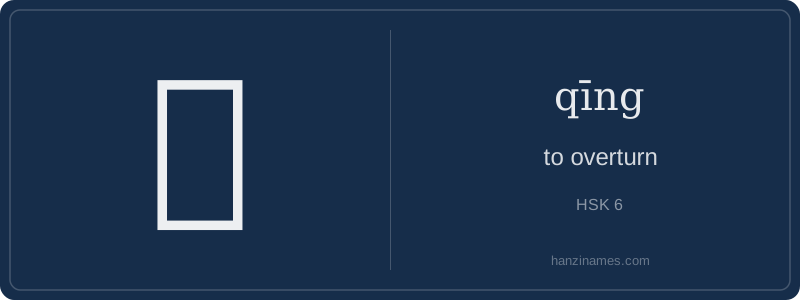
In contemporary China, 倾 is most commonly encountered in formal and media contexts: news reports use 倾泻 (qīngxiè) for sudden floods or data surges; business analysts cite 倾销 (qīngxiāo) when discussing WTO anti-dumping rulings against Chinese exports; and educators emphasize 倾听 (qīngtīng) as a core pedagogical skill—reflecting Confucian ideals of respectful attention. The idiom 倾国倾城 (qīngguó qīngchéng), from the *Book of Han*, remains widely cited to describe breathtaking beauty capable of toppling kingdoms—a metaphor still deployed in literature and film criticism.
The character evolved from seal script (c. 3rd century BCE), where 顷 depicted a person bending sideways—visually echoing its meaning of ‘leaning over’. Though no oracle-bone form survives, early bronze inscriptions show consistent use of the 亻+顷 structure by the Warring States period, confirming its long-standing semantic link to directional force and instability.
Imagine a rain-soaked alley in Chengdu’s historic Jinli district, where a street vendor’s bamboo cart teeters precariously on wet stone. With a sudden lurch, the cart tilts—its steaming pot of mapo tofu begins to qīng: liquid surging sideways, chili oil spilling like crimson lava. This visceral moment captures 倾’s core sense: not just ‘to overturn’ mechanically, but to tip, lean, or倾泻 (pour out) with irreversible momentum—whether physical, emotional, or systemic.
The character 倾 embodies dynamic imbalance. Its left radical 亻 (‘person’) signals human agency or involvement; the right component 顷 (qǐng) originally meant ‘a short time’ but here functions phonetically while reinforcing transience—like a momentary loss of equilibrium. In modern usage, 倾 rarely appears alone; it thrives in compounds expressing intense directionality:倾心 (to devote one’s heart), 倾销 (dumping goods at cut-rate prices), or 倾听 (to listen attentively—literally ‘lean-in listening’).
Historically, 倾 carried moral weight: in the *Zuo Zhuan* (c. 4th century BCE), it described states ‘overturning’ ritual order, and during the Ming-Qing transition, loyalist writers used 倾覆 (qīngfù) to lament dynastic collapse. Today, it surfaces in headlines about market crashes (股市倾泻, ‘stock market deluge’) or environmental crises (山体倾塌, ‘mountain slope collapse’)—always evoking consequence, urgency, and irreversible change.
Example Sentences
Common Compounds
Similar Characters — Don't Mix These Up
Your First Step into Chinese Culture: Get a Chinese Name
Every journey into Chinese begins with a name. Use our free Chinese name generator to create a meaningful, personalized Chinese name that fits you perfectly.
Get My Chinese Name →