侨
Character Story & Explanation
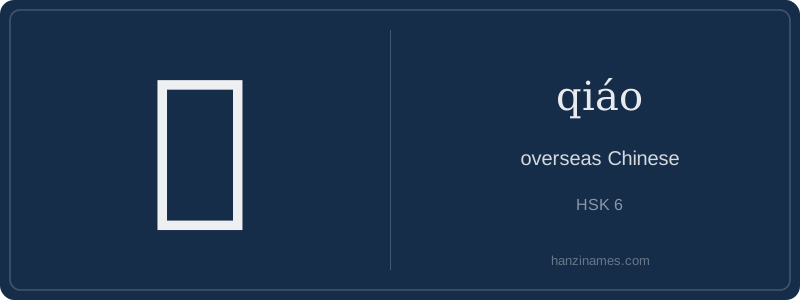
侨 is widely used in official, media, and community contexts across Greater China. The State Council’s Overseas Chinese Affairs Office (now merged into the United Front Work Department) historically administered policies for 侨胞 (qiáobāo, 'fellow overseas Chinese'), and terms like 侨汇 (qiáohuì, remittances from abroad) were vital to China’s economy—peaking at over 10 billion USD annually in the 1980s–90s. Common idioms include 落叶归根 (luòyè guīgēn, 'fallen leaves return to their roots'), reflecting the 侨 ideal of eventual return.
The character 侨 is a phono-semantic compound: radical 亻 (person) + phonetic 桥 (qiáo, 'bridge'). Its earliest attested form appears in seal script (c. 3rd century BCE), where 桥 served purely as a sound clue—no pictographic bridge element remains. It does not depict migration literally but evokes connection across distance, much like a bridge linking two shores.
The Chinese character 侨 (qiáo) denotes a person who resides abroad while retaining cultural, legal, or ancestral ties to China—commonly translated as 'emigrant' or 'overseas Chinese.' Unlike the English term 'immigrant,' which emphasizes arrival and settlement in a new country, 侨 carries an implicit orientation toward the homeland: it presupposes continued identification with China, often including citizenship, familial roots, or official recognition by Chinese institutions.
This distinction reflects Confucian-influenced concepts of belonging, where geographic displacement doesn’t sever filial or national duty. In practice, 侨 is rarely used for naturalized citizens who fully assimilate and renounce Chinese ties; instead, it describes those maintaining active engagement—such as sending remittances, participating in hometown associations, or voting in overseas consular elections (where permitted).
Western equivalents like 'diaspora member' or 'expatriate' lack 侨’s institutional specificity. 'Expatriate' often connotes temporary, privileged residence (e.g., corporate assignees), while 'diaspora' is academic and broad. 侨, by contrast, is a legally defined category in Chinese law—governed by the PRC’s Regulations on the Protection of the Rights and Interests of Overseas Chinese (2020)—making it both sociocultural and juridical.
Example Sentences
Common Compounds
Similar Characters — Don't Mix These Up
Your First Step into Chinese Culture: Get a Chinese Name
Every journey into Chinese begins with a name. Use our free Chinese name generator to create a meaningful, personalized Chinese name that fits you perfectly.
Get My Chinese Name →