僻
Character Story & Explanation
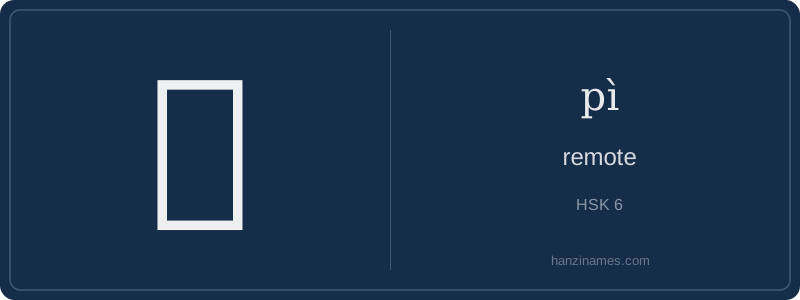
僻 appears in classical and modern Chinese to describe geographically isolated areas or culturally marginal ideas. It’s central in the idiom 僻壤 (pì rǎng) — 'remote territory' — used historically in texts like the Book of Han to refer to frontier regions beyond imperial control. In modern usage, 僻 is common in formal writing: news reports on infrastructure development in 僻远山区 (pì yuǎn shān qū, 'remote mountainous areas'), or academic critiques of 僻论 (pì lùn, 'eccentric theories').
The character’s form is not pictographic; it evolved from seal script where 亻 + 辟 represented a person in an avoided or untraveled place. Its modern shape reflects standardized clerical script — no oracle-bone origins are documented. Today, Chinese speakers use 僻 most often in compound words, rarely alone — especially when discussing rural development, cultural preservation, or intellectual dissent.
Hi everyone! Today we’re learning the character 僻 (pì), which means 'remote', 'secluded', or 'out-of-the-way'. It’s an HSK Level 6 character — so it’s advanced, but very useful for describing places far from cities or mainstream culture. Notice its radical is 亻 (the 'person' radical), telling us it relates to human experience — not just geography, but how people live, think, or behave in isolation.
The right side, 辟 (bì/pì), is both a phonetic component and a meaningful one: it originally meant 'to open up' or 'to avoid', and in compounds often carries connotations of exclusivity or deviation. So 僻 subtly combines physical distance with social or intellectual separation — like a village cut off by mountains, or a scholar with unconventional ideas.
Don’t confuse it with similar-sounding characters like 避 (bì, 'to avoid') or 壁 (bì, 'wall'). Pronunciation matters: pì has the fourth tone — sharp and falling, like a firm 'no'. Practice saying it while imagining a narrow mountain path disappearing into mist — that’s the feeling of 僻!
Example Sentences
Common Compounds
Similar Characters — Don't Mix These Up
Your First Step into Chinese Culture: Get a Chinese Name
Every journey into Chinese begins with a name. Use our free Chinese name generator to create a meaningful, personalized Chinese name that fits you perfectly.
Get My Chinese Name →