么
Character Story & Explanation
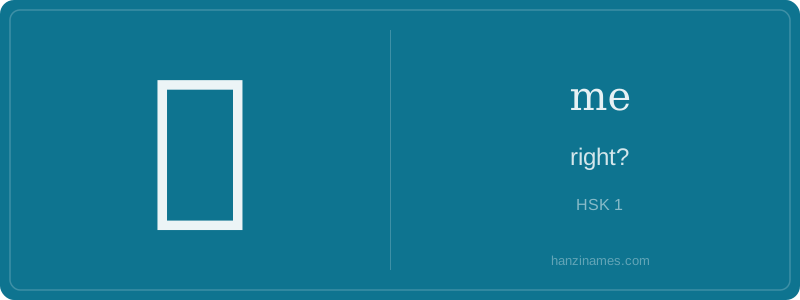
么 is one of the most frequently used sentence-final particles in contemporary Standard Mandarin, especially in northern dialects and formal education materials. It appears in over 90% of beginner-level dialogues in official HSK textbooks. While absent from Classical Chinese, it became standardized in the 20th century as part of the national language reform. You’ll hear it in phrases like ‘好么?’ (Hǎo me? — 'Okay?') or ‘行么?’ (Xíng me? — 'Is that alright?'), where it signals polite checking rather than demanding confirmation.
The character 么 has no pictographic origin — it evolved from the cursive form of 么 (an archaic variant of 无, wú, meaning 'not') during the Song-Yuan period, later repurposed phonetically as a grammatical particle. Today, its written form is purely conventional: three strokes (丿、一、丶), with no visual connection to meaning — making it a great example of how Chinese characters can shift function across history.
Hi students! Let’s talk about the character 么 (me). It’s a tiny but powerful particle — just three strokes, and it’s HSK Level 1, so you’ll see it very early in your Chinese studies. Unlike most characters, 么 isn’t a standalone word with its own meaning like 'cat' or 'water'. Instead, it’s a grammatical helper — mainly used at the end of questions or exclamations to soften tone, add curiosity, or express mild surprise. Think of it like adding 'ever' in 'Who *ever* said that?' — not essential for grammar, but full of nuance.
Don’t confuse 么 with question words like 什么 (shénme, 'what') — 么 here is only the *suffix*, never used alone as a noun. Its pronunciation is almost always 'me' (light third tone), though in fast speech it may sound like 'ma' due to tone sandhi — especially after rising-tone syllables. Native speakers rarely stress it; it glides out gently, like a little puff of air after a sentence.
This character appears *only* in modern written and spoken Mandarin — it doesn’t exist in Classical Chinese or ancient inscriptions. You’ll find it in everyday dialogues, textbooks, subtitles, and WeChat messages. Since it’s a grammatical particle, mastering 么 helps you sound more natural and less textbook-y. Remember: it’s not about memorizing definitions — it’s about *feeling* how it shapes rhythm and attitude in speech. With practice, you’ll start hearing it everywhere!
Example Sentences
Common Compounds
Similar Characters — Don't Mix These Up
Your First Step into Chinese Culture: Get a Chinese Name
Every journey into Chinese begins with a name. Use our free Chinese name generator to create a meaningful, personalized Chinese name that fits you perfectly.
Get My Chinese Name →