凄
Character Story & Explanation
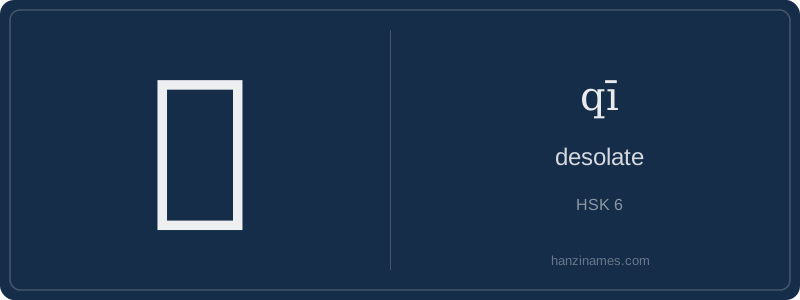
Historically, 凄 appears in Tang and Song dynasty poetry to evoke sorrow-laden wintry scenes — Du Fu’s lines describe ‘凄风’ (qī fēng, 'biting, mournful wind') sweeping ruined villages. In modern usage, it survives primarily in fixed literary compounds: 凄惨 (qīcǎn, 'miserable'), 凄凉 (qīliáng, 'desolate'), and 凄厉 (qīlì, 'piercingly shrill'). It rarely stands alone in daily speech; native speakers use it deliberately for rhetorical weight — e.g., news headlines describing disaster aftermath ('场面凄惨') or film reviews praising atmospheric dread ('音效凄厉').
The character’s origin is documented as phono-semantic: 冫 (ice radical, semantic) + 妻 (qī, phonetic, borrowed for sound only). No oracle bone or bronze inscription evidence exists for 凄 — it first appears reliably in Han dynasty texts. Today, Chinese learners encounter it in HSK 6 reading passages about classical literature or emotional nuance — never in grocery lists or weather reports.
Our investigation begins at the crime scene: the character 凄 (qī), a 10-stroke glyph bearing the ice radical 冫—immediately signaling cold, not mere chill, but penetrating, desolate cold. Early seal script forms show 冫 paired with 凄’s right side, which evolved from 凄 (a variant of 悽) — itself derived from 妻 (qī, 'wife') as a phonetic component, not semantic. This is no pictograph of frost, but a phono-semantic compound: coldness conveyed through sound and radical, not image.
Zooming in on the radical: 冫 (bīng) is the ‘ice’ radical — always appearing on the left in characters related to cold, freezing, or bleakness (e.g., 冷 lěng 'cold', 冻 dòng 'freeze'). Its two dots represent frozen droplets — a standardized shorthand, not a literal ice crystal. The right side, 妻, was borrowed purely for pronunciation; over centuries, its visual link to 'wife' faded, leaving only phonetic residue. No marital meaning survives — only the haunting echo of qī.
This character doesn’t whisper — it wails. 凄 carries emotional frigidity: grief so deep it chills the air, loneliness so absolute it freezes time. Its power lies in fusion: physical cold + psychological desolation. Unlike 冷 (neutral 'cold') or 寒 (seasonal 'cold'), 凄 implies atmosphere — a wind-scoured graveyard, an abandoned theater after tragedy, a silent letter from a lost love. It’s literary, poetic, high-register — rarely used in casual speech, but unforgettable in classical poetry and modern prose where emotional extremity demands lexical frostbite.
Example Sentences
Common Compounds
Similar Characters — Don't Mix These Up
Your First Step into Chinese Culture: Get a Chinese Name
Every journey into Chinese begins with a name. Use our free Chinese name generator to create a meaningful, personalized Chinese name that fits you perfectly.
Get My Chinese Name →