凝
Character Story & Explanation
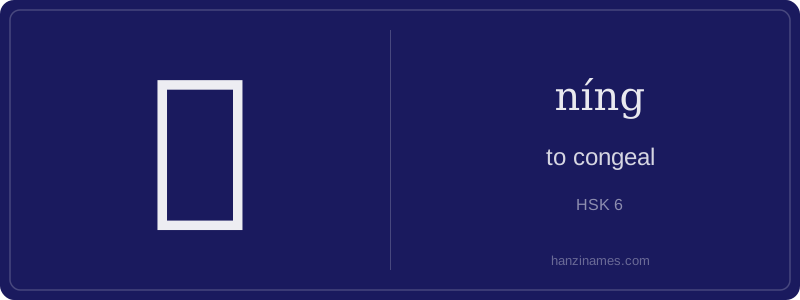
凝 is widely used in modern Mandarin in both scientific and literary registers: in medicine (凝血 ‘blood coagulation’), meteorology (凝结 ‘condensation’), and expressive language (凝神 ‘to concentrate one’s mind’). It appears in the HSK 6 idiom 凝神静气 (níng shén jìng qì), meaning ‘to calm the mind and gather focus’, commonly taught in stress-reduction and martial arts contexts. Historically, it appears in Tang dynasty poetry and Song medical texts like the Compendium of Materia Medica (Bencao Gangmu) discussing herbal coagulants.
The character’s form combines the radical 冫 (bīng, ‘ice’) on the left—indicating cold-related transformation—and 疑 (yí, ‘to doubt’) on the right, which serves phonetically (both share the -íng/-í rhyme in Middle Chinese). Though 疑 originally meant ‘doubt’, here it’s purely phonetic; no semantic link to uncertainty exists. This is a well-documented case of phono-semantic compounding, confirmed by Shuowen Jiezi (100 CE) and modern paleography.
‘凝’ (níng) conveys the physical process of substances thickening or solidifying—like water freezing into ice or blood clotting—but extends metaphorically to mental and emotional states: intense focus, frozen attention, or suspended time. Unlike English ‘congeal’, which often carries negative connotations (e.g., ‘congealed fat’), 凝 is neutral-to-positive in Chinese, especially in literary or poetic contexts where it evokes stillness, depth, and quiet intensity.
In Western thought, ‘congeal’ typically signals decay or stagnation—think of horror films where fog ‘congeals’ before a threat emerges. By contrast, 凝 in classical Chinese poetry (e.g., Du Fu’s lines) describes serene, deliberate concentration—comparable to a Zen monk’s unwavering gaze or a painter’s absorbed stillness before the canvas. It implies agency and refinement, not passive hardening.
Culturally, this reflects Daoist and Confucian values:凝 embodies the ideal of focused tranquility—‘still water reflects the moon’. Western equivalents like ‘coagulate’ or ‘curdle’ lack this philosophical resonance. Even ‘crystallize’ comes close (as in ‘ideas crystallize’), but lacks 凝’s visceral physicality and its frequent use in describing gaze, silence, or atmosphere—e.g., ‘a凝重的神情’ (a solemn, weighty expression), where gravity is both emotional and almost tactile.
Example Sentences
Common Compounds
Similar Characters — Don't Mix These Up
Your First Step into Chinese Culture: Get a Chinese Name
Every journey into Chinese begins with a name. Use our free Chinese name generator to create a meaningful, personalized Chinese name that fits you perfectly.
Get My Chinese Name →