凡
Character Story & Explanation
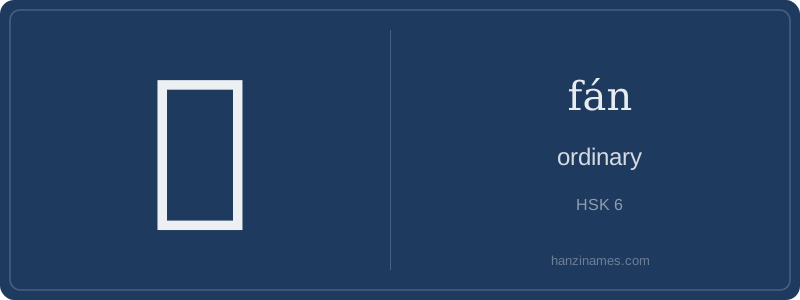
In modern Chinese, 凡 functions primarily as an adverb meaning ‘all’, ‘every’, or ‘any’, especially in formal, legal, or literary contexts—e.g., 凡事 (fánshì, ‘everything’), 凡人 (fánrén, ‘ordinary person’), and the idiom 凡事预则立 (fánshì yù zé lì, ‘those who prepare for everything succeed’). It appears in official documents, academic writing, and classical allusions—not in casual speech. Historically, it was central to Daoist and Confucian discourse distinguishing sages from the ‘ordinary’ (凡夫, fánfū) masses.
The character has no verified pictographic origin. Scholars agree it is not derived from a physical object. Instead, its earliest secure attestation is in the *Shuōwén Jiězì*, where it’s defined semantically—not visually. Today, Chinese learners encounter it most often in set phrases like 凡此种种 (fán cǐ zhǒng zhǒng, ‘all such things’) or bureaucratic notices: ‘凡报名者须…’ (‘All applicants must…’).
Our investigation begins with the oracle bone and bronze inscriptions—yet 凡 leaves no clear trace there. Unlike many early characters, it doesn’t appear in Shāng or early Zhōu divinatory texts. Instead, 凡 emerges fully formed in Warring States bamboo slips and the *Shuōwén Jiězì* (121 CE), where Xǔ Shèn classifies it under the radical 几 (‘table’ or ‘low seat’) and defines it as ‘common, ordinary’—already carrying its core semantic weight. Its minimalist three-stroke structure suggests deliberate simplification, not pictographic origin.
Zooming in on the form: the top horizontal stroke (一) anchors the character; the left-falling stroke (丿) slants decisively; the final dot-like stroke (丶) isn’t decorative—it’s a functional terminal mark distinguishing 凡 from similar shapes like 几 or 丸. This dot appears consistently across Han dynasty clerical script and later standard forms, signaling grammatical or lexical specificity rather than visual ornamentation.
Forensic paleography reveals no evolution *from* a concrete object—no vessel, no person, no tool. Instead, 凡 likely arose as a phonosemantic compound that lost its phonetic component over time, or as a ‘borrowed character’ (jiǎjiè) repurposed for the abstract concept of ‘ordinariness’. Its stability across 2,000 years—unchanged in form and meaning—suggests it filled a precise lexical niche: the conceptual anchor for ‘the non-exceptional’, essential for classical philosophical contrast (e.g., ‘sages vs. the ordinary’).
Example Sentences
Common Compounds
Similar Characters — Don't Mix These Up
Your First Step into Chinese Culture: Get a Chinese Name
Every journey into Chinese begins with a name. Use our free Chinese name generator to create a meaningful, personalized Chinese name that fits you perfectly.
Get My Chinese Name →