凸
Character Story & Explanation
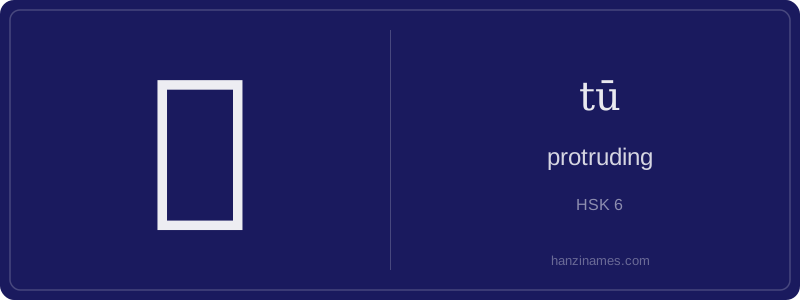
凸 is rarely used alone in modern Mandarin—it almost always appears in compounds like 凸透镜 (tūtòujìng, 'convex lens') or 凸起 (tūqǐ, 'bulge/protrusion'). It features in technical standards (e.g., GB/T 1800.1–2018 on mechanical tolerances), architectural blueprints, and medical imaging reports. A documented idiomatic use appears in the phrase 凸凹不平 (tū’āo bù píng, 'uneven surface'), listed in the Contemporary Chinese Dictionary (7th ed., 2016). Historically, it was absent in classical texts but entered vernacular scientific translation in the late Qing and Republican eras to render Western geometric terms.
The character’s form is not pictographic but diagrammatic: its structure visually encodes convexity—two outward-slanting strokes flanking a central vertical rise within a downward-opening radical (凵). This design, standardized by the Shuōwén Jiězì, has remained unchanged for nearly 2,000 years—a rare case of deliberate geometric abstraction in Chinese script.
Our detective work begins with the oracle-bone and bronze inscriptions—but here, the trail goes cold: 凸 has no verified early forms in Shang or Zhou scripts. It first appears reliably in the Han dynasty’s Shuōwén Jiězì (121 CE), where Xu Shen classifies it under radical 凵 (kǎn, 'hollow' or 'open container') and defines it as ‘a shape rising up from a depression’—a precise visual logic. Its five-stroke structure is deliberately asymmetrical: the top horizontal stroke anchors the form, while the descending left and right strokes frame an upward bulge, mirroring the physics of convexity.
This character was never a pictograph of a physical object like sun or tree—but a diagrammatic glyph. The radical 凵 suggests containment or boundary; the internal stroke (丨) pierces upward, and the two diagonal strokes (丿 and 丶) tilt outward, visually enacting ‘protrusion’. Unlike many radicals that evolved from concrete images, 凸 was engineered as a schematic sign—making it one of Chinese writing’s earliest examples of abstract geometric notation.
Its semantic range—‘to stick out’, ‘convex’, and even the colloquial slang meaning ‘male’ (as in 凸点 for ‘penis’, used in medical or internet contexts)—stems from this core idea of outward projection. Even the HSK 6 placement reflects its specialized, non-frequent but conceptually dense usage: it appears not in daily verbs or nouns, but in technical terms (optics, geometry, anatomy), literary metaphors, and digital slang where visual morphology matters more than frequency.
Example Sentences
Common Compounds
Similar Characters — Don't Mix These Up
Your First Step into Chinese Culture: Get a Chinese Name
Every journey into Chinese begins with a name. Use our free Chinese name generator to create a meaningful, personalized Chinese name that fits you perfectly.
Get My Chinese Name →