剥
Character Story & Explanation
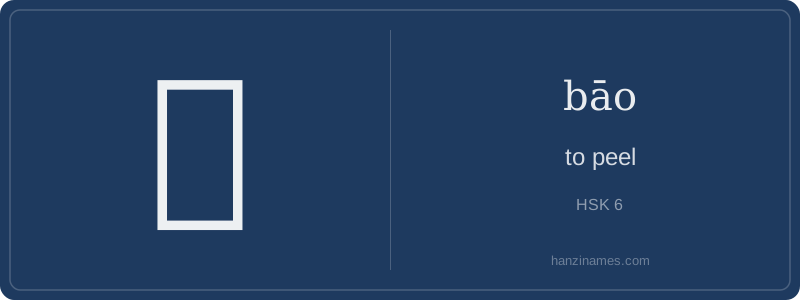
剥 is widely used in daily life: from cooking instructions (‘剥蒜’ *bāo suàn*, 'peel garlic') to technical terms like 剥离 (*bōlí*, 'delamination' in materials science) and legal phrases like 剥夺 (*bōduó*, 'to deprive'—e.g.,剥夺政治权利, 'deprivation of political rights'). A well-documented idiom is 剥茧抽丝 (*bō jiǎn chōu sī*, 'peel the cocoon and draw out the silk'), meaning to unravel complexity step by step—used in education and policy analysis since at least the Qing dynasty.
The character’s form combines the radical 刂 ('knife') on the right and 彔 (a variant of 录, historically linked to recording/processing) on the left. While its earliest seal script forms (c. 3rd c. BCE) show a hand holding a knife near a fruit-like shape, scholars confirm its core semantic link to cutting away outer layers—not as violence, but as necessary preparation. Today, Chinese parents commonly say '把橘子剥开' (*bǎ júzi bāo kāi*) while helping children with snacks, making it one of the first verbs of care and practical wisdom they internalize.
The character 割 (bāo) embodies a quiet yet profound aspect of the Chinese worldview: transformation through careful, intentional removal. Peeling isn’t destruction—it’s preparation, revealing what lies beneath—be it the tender flesh of a tangerine, the truth behind rhetoric, or the essence of a complex idea. This reflects the Confucian and Daoist value of discernment: not rejecting surface appearances outright, but skillfully stripping away the non-essential to access authenticity and function.
In Chinese thought, ‘peeling’ mirrors self-cultivation—shedding ego, pretense, or outdated habits to uncover one’s true nature (本性). The dual pronunciation (bāo for physical peeling; bō in abstract contexts like 剥削 *bōxuē*, 'exploitation') reveals linguistic nuance: same root action, divergent moral valence. Thus, 剥 is never neutral—it invites ethical reflection on *who* does the peeling, *what* is removed, and *for whose benefit*.
This duality resonates in classical texts and modern usage alike. When Mencius speaks of ‘peeling away falsehood to reveal benevolence’, or when contemporary journalists use 剥离 (*bōlí*, 'to disentangle') to analyze systemic issues, 剥 becomes a cognitive and moral verb—a tool for clarity in a world saturated with layers of meaning, power, and performance.
Example Sentences
Common Compounds
Similar Characters — Don't Mix These Up
Your First Step into Chinese Culture: Get a Chinese Name
Every journey into Chinese begins with a name. Use our free Chinese name generator to create a meaningful, personalized Chinese name that fits you perfectly.
Get My Chinese Name →