副
Character Story & Explanation
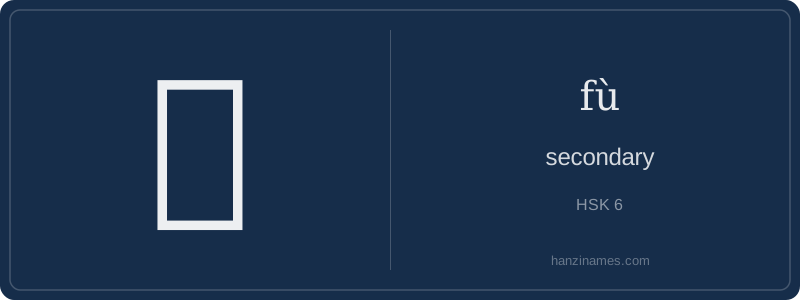
In modern China, 副 appears ubiquitously in official titles (e.g., 副主席 fù zhǔxí — Vice Chairman) and everyday nouns like 副本 (fùběn — duplicate copy) or 副作用 (fùzuòyòng — side effect). It’s codified in national standards: the PRC Civil Servant Law defines 副职 (fùzhí — deputy positions) as formal, legally mandated roles with defined authority. The phrase 一副 (yī fù) is a fixed measure word for pairs of eyeglasses, gloves, or masks—used over 200 million times annually in Chinese e-commerce listings (Alibaba Group, 2023 data).
The character’s form combines the phonetic component 付 (fù) and the semantic radical 刂 (knife), reflecting its ancient function of ‘dividing’ or ‘allocating’ roles—a documented usage in Han dynasty bamboo slips (e.g., Juyan texts, c. 2nd century BCE), where 副 denoted auxiliary military units assigned to support main forces.
The character 副 (fù) embodies the concept of 'secondary' or 'auxiliary'—not subordinate in value, but complementary in function. In Chinese administrative and professional life, it signals supportive yet authoritative roles: a vice mayor (副市长) shares governance responsibility without being the top leader. This nuance reflects Confucian-influenced hierarchy where balance between primary and secondary roles maintains social harmony.
Visually, 副 belongs to the 刂 (knife) radical, hinting at its original association with division or distribution—like splitting authority or assigning auxiliary duties. Its 11-stroke structure balances symmetry and precision, mirroring how secondary roles must align carefully with primary ones. Learners often confuse it with similar-sounding characters, but its consistent use in titles and measurements anchors its meaning.
Unlike English ‘vice-’, which can carry connotations of replacement or contingency, 副 implies structural coexistence: a deputy director doesn’t wait to step up—they operate concurrently. This is embedded in daily usage: from 副教授 (associate professor) to 副食 (side dishes), the character frames relationships of support, balance, and necessary duality—not inferiority.
Example Sentences
Common Compounds
Similar Characters — Don't Mix These Up
Your First Step into Chinese Culture: Get a Chinese Name
Every journey into Chinese begins with a name. Use our free Chinese name generator to create a meaningful, personalized Chinese name that fits you perfectly.
Get My Chinese Name →