勘
Character Story & Explanation
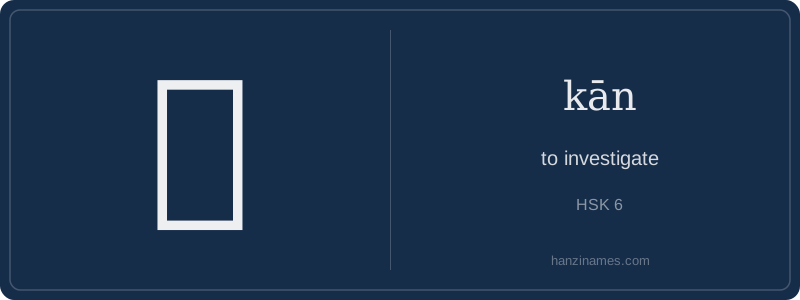
勘 is widely used in modern Chinese professional life: land surveyors use 勘测 (kāncè) for topographic mapping; auditors conduct 财务勘验 (cáiwù kānyàn, 'financial verification'); and journalists perform 新闻勘误 (xīnwén kānwù, 'news correction'). A well-documented phrase is 勘察现场 (kānchá xiànchǎng, 'inspect the scene'), standard in police and engineering reports. The term appears in China’s national surveying standards and official press releases about infrastructure projects.
The character evolved from seal script, where the left part 甚 originally meant 'extreme' or 'thorough', and the right 力 emphasized 'exertion'. Together, they conveyed 'thorough effort to verify'. No oracle-bone form survives, but by the Han dynasty, 勘 was already used in legal and geographical texts to mean 'on-site verification'—a meaning unchanged for over 2,000 years.
Hi students! Let’s learn 勘 (kān), a Level 6 HSK character meaning 'to investigate' or 'to survey'. It’s not about casual looking—it’s formal, professional investigation: checking facts, verifying data, or inspecting terrain. Think of engineers surveying land before building a bridge, or editors checking manuscripts for errors. The character combines 力 (lì, 'strength' or 'effort') with 甚 (shèn, 'extremely'), suggesting *intense, effortful examination*—not just glancing, but digging deep.
This character appears in serious, technical, or administrative contexts—not everyday chat. You’ll rarely hear it in spoken Mandarin unless someone is reporting on fieldwork, audits, or academic verification. It’s more common in written reports, official documents, news headlines, and professional jargon. Its tone is precise and authoritative, so mastering it helps you understand China’s infrastructure, journalism, and quality-control culture.
Don’t confuse 勘 with similar-sounding words like 看 (kàn, 'to look') or 刊 (kān, 'to publish'). 勘 is deliberate, methodical, and often involves experts using tools or data. When you see it, imagine geologists with GPS devices, auditors with spreadsheets, or historians cross-referencing ancient texts. Practice writing it slowly—11 strokes, starting with the radical 力 on the right—and remember: every stroke reflects careful, purposeful work.
Example Sentences
Common Compounds
Similar Characters — Don't Mix These Up
Your First Step into Chinese Culture: Get a Chinese Name
Every journey into Chinese begins with a name. Use our free Chinese name generator to create a meaningful, personalized Chinese name that fits you perfectly.
Get My Chinese Name →