勾
Character Story & Explanation
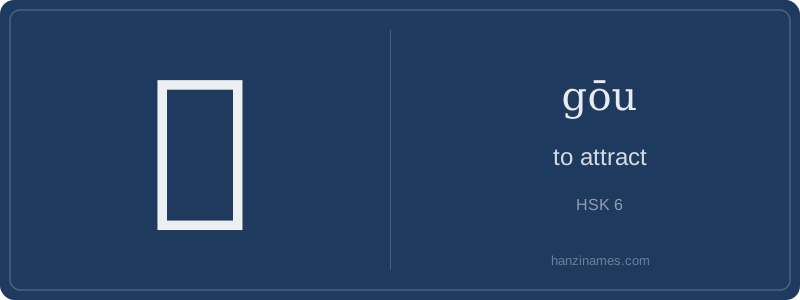
In modern Chinese, 勾 appears daily in digital interfaces (勾选 ‘check/select’), official forms (勾掉 ‘cross out’), and idioms like 勾心斗角 (gōu xīn dòu jiǎo, ‘intrigue and rivalry’), first recorded in Du Mu’s Tang dynasty poem ‘Afang Palace’. Historically, it denoted administrative marking—Qing dynasty tax records used 勾 to confirm verified entries. Its ‘attract’ sense thrives in marketing (勾起兴趣 ‘spark interest’) and literature (勾人魂魄 ‘captivate souls’).
The character’s written form derives from seal script, where 勹 (radical) wraps a simplified 句 (jù, ‘sentence’ or ‘curve’), not a pictograph. No oracle-bone form is confirmed; the earliest reliable appearance is in Warring States bamboo slips. Today, Chinese students learn its stroke order early—but mastery comes at HSK 6, when they parse nuanced contexts like 勾连 (collusion) vs. 勾勒 (outline sketch).
As a detective tracing 勾’s evolution, I begin at the oracle-bone and bronze inscriptions—where no clear pictographic origin survives. Unlike sun (日) or tree (木), 勾 lacks definitive early pictorial evidence. Instead, its earliest attested form in Shuōwén Jiězì (121 CE) classifies it under radical 勹 (‘to wrap’ or ‘to enclose’), suggesting conceptual roots in curving, enclosing motion—not visual representation. Its four-stroke simplicity belies semantic richness: the hook-like shape implies grasping, pulling, or drawing in.
The character’s core meaning ‘to attract’ emerged later through semantic extension: a hook (gōu) physically pulls objects toward itself—so metaphorically, it came to mean ‘to lure’ or ‘to captivate’. This shift is documented in classical texts like the Zhuāngzǐ, where 勾 describes enticing influence over minds and desires. The radical 勹 reinforces this: enclosing implies containment and control, aligning with attraction as an act of drawing something into one’s sphere.
By the Tang and Song dynasties, 勾 had solidified its dual roles: as a verb meaning ‘to attract’ (e.g., 勾魂 ‘to captivate utterly’) and as a noun for ‘hook’ or ‘checkmark’. Its HSK 6 status reflects this lexical sophistication—learners must grasp both concrete and abstract uses, often distinguished only by context. Crucially, 勾 never meant ‘to draw’ in the artistic sense (that’s 画 huà); its drawing is purposeful, directional, and often psychological—like a magnet pulling attention.
Example Sentences
Common Compounds
Similar Characters — Don't Mix These Up
Your First Step into Chinese Culture: Get a Chinese Name
Every journey into Chinese begins with a name. Use our free Chinese name generator to create a meaningful, personalized Chinese name that fits you perfectly.
Get My Chinese Name →