卓
Character Story & Explanation
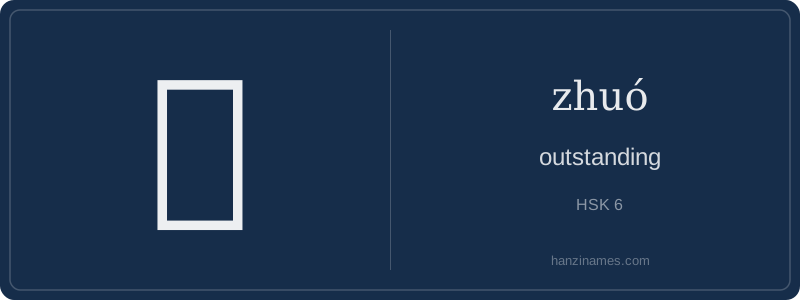
In contemporary China, 卓 appears most frequently in formal, aspirational contexts: academic awards (‘卓越青年学者奖’), corporate mission statements (e.g., Huawei’s ‘追求卓越’), and official media coverage of scientific or cultural achievements. The idiom 卓尔不群 (zhuó’ěr bù qún)—‘standing out distinctively among peers’—is widely cited in education policy documents and university commencement speeches. It’s also embedded in standardized testing: 卓 appears in HSK 6 vocabulary lists with consistent frequency in reading comprehension passages about innovation and leadership.
The character 卓 is not pictographic. Its earliest attested form appears in Warring States bamboo slips (c. 475–221 BCE) as a phonosemantic compound: 十 (radical, possibly indicating ‘completeness’ or ‘foundation’) + 早 (early, here serving mainly for sound). Scholars agree its meaning evolved from ‘high platform’ (archaic sense) to ‘eminent’ through semantic extension—not from oracle bone script, which lacks this character.
Imagine walking into the Shanghai Science and Technology Museum on a rainy Tuesday. A crowd gathers around a holographic display of Chang’e-5’s lunar sample return—China’s first robotic mission to bring back moon rocks. A young researcher, Dr. Lin, steps forward to explain the breakthrough. Her colleagues whisper: ‘她真是卓尔不群!’ (She’s truly outstanding!). Here, 卓 isn’t abstract—it’s the quiet awe in a packed auditorium, the weight of excellence made visible in real time.
Historically, 卓 carried connotations of elevation and prominence—literally ‘standing tall.’ In classical texts like the *Book of Rites*, it described virtuous conduct that rose above convention. Today, it retains that vertical metaphor: not just ‘good,’ but *uniquely elevated*—a quality that commands attention without shouting. It implies rarity, integrity, and measurable impact, not mere praise.
The character’s eight strokes form a deliberate structure: the 十 (ten) radical at the top anchors it like a foundation, while the lower part (早 minus 日) suggests ‘early arrival’—hinting that true excellence often comes from foresight and preparation. In modern usage, 卓 is rarely used alone; it thrives in compounds like 卓越 (zhuóyuè, ‘excellence’) and 卓识 (zhuóshí, ‘penetrating insight’), where its gravity elevates the entire phrase beyond ordinary competence.
Example Sentences
Common Compounds
Similar Characters — Don't Mix These Up
Your First Step into Chinese Culture: Get a Chinese Name
Every journey into Chinese begins with a name. Use our free Chinese name generator to create a meaningful, personalized Chinese name that fits you perfectly.
Get My Chinese Name →