叨
Character Story & Explanation
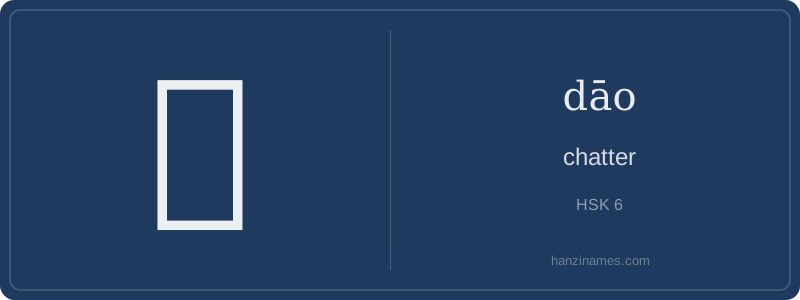
叨 is rarely used independently in modern spoken Mandarin. Its primary real-world function is in the humble expression 叨教 (tāo jiào), widely employed in emails, academic correspondence, and formal requests for feedback — e.g., 'Please 叨教 my draft.' It also appears in the idiom 叨陪末座 (tāo péi mò zuò), meaning 'to humbly occupy the lowest seat,' signaling deference in gatherings. Historically, 叨 appears in the Classic of Poetry (Shījīng) and later texts with meanings like 'to seize' or 'to partake,' evolving toward verbal intrusion.
The character is not a pictograph but a phono-semantic compound: 口 (mouth, semantic) + 刀 (dāo, 'knife', phonetic). While 刀 originally meant 'knife,' here it serves purely for sound — a common pattern in Chinese character formation. No oracle bone or bronze script forms of 叨 survive; it first appears reliably in seal script (c. 3rd century BCE), already with its dual readings and humility usage.
Our detective begins at the crime scene: the character 叨, a deceptively simple five-stroke glyph with 口 (mouth) as its radical. At first glance, it looks like a mouth talking incessantly — and indeed, its core semantic field revolves around excessive or intrusive speech. The left component, 刀 (dāo, 'knife'), is not a pictorial knife here but a phonetic clue: in Middle Chinese, 刀 and 叨 shared near-identical pronunciation, anchoring the dāo reading. This phonosemantic structure — mouth + sound hint — is classic for speech-related characters.
But wait: why two readings? Our dossier reveals tāo appears almost exclusively in the fixed phrase 叨教 (tāo jiào), meaning 'to humbly seek instruction' — a modesty formula where 叨 implies 'presuming to ask' or 'daring to trouble'. Here, tāo carries a softened, self-deprecating nuance, distinct from the sharper 'garrulous' sense of dāo. This duality isn’t contradiction — it’s linguistic layering: one sound for blabber, another for polite intrusion, both rooted in the mouth’s power to overstep.
Forensic stroke analysis confirms discipline: 口 (3 strokes) drawn first, then 刀 (2 strokes) inserted neatly inside — not overlapping, not rushed. Its HSK 6 status reflects rarity: it’s not in daily vocabulary like 说 or 讲, but appears in literary idioms, classical allusions, and formal humility expressions. Learners often misread it as 刀 alone; our detective warns: the enclosing 口 transforms the blade into speech — a reminder that in Chinese script, context is the ultimate witness.
Example Sentences
Common Compounds
Similar Characters — Don't Mix These Up
Your First Step into Chinese Culture: Get a Chinese Name
Every journey into Chinese begins with a name. Use our free Chinese name generator to create a meaningful, personalized Chinese name that fits you perfectly.
Get My Chinese Name →