叭
Character Story & Explanation
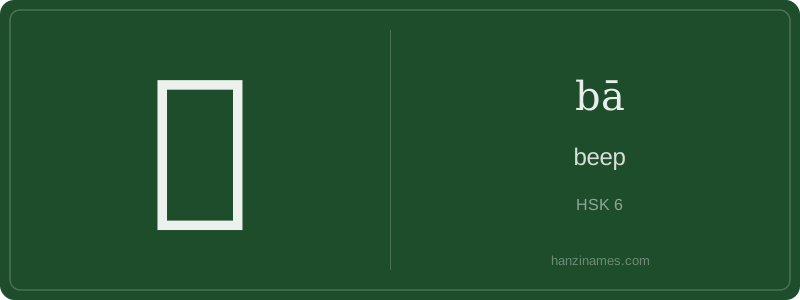
In contemporary Chinese, 叭 appears almost exclusively in onomatopoeic expressions—not as a standalone word, but within phrases like 叭叭 (bā bā, honking), 叭地 (bā dì, a sharp crack), or in reduplicated forms in children’s literature and cartoons. It’s documented in authoritative dictionaries including the Xiàndài Hànyǔ Cídiǎn (7th ed., 2016) as a拟声词 (sound-mimicking character). No classical idiom or ancient text uses 叭 independently; it emerged later as vernacular writing formalized sound representation.
The character is a clear phono-semantic compound: 口 (kǒu, ‘mouth’) as the semantic radical indicates sound production, and 八 (bā) as the phonetic component confirms pronunciation. While 八 originally meant ‘eight’, its shape was borrowed here purely for sound—no numeric meaning is implied. This is a textbook case of phonetic loan usage in modern Chinese orthography.
Imagine standing on a bustling Beijing hutong alley at dawn—suddenly, a bicycle bell rings: bā! That sharp, crisp sound is precisely what the character 叭 captures. It’s not a word with abstract meaning, but an onomatopoeic glyph designed to mimic short, abrupt noises—like a car horn, a dog’s bark, or a startled shout. Its simplicity (just five strokes) reflects its function: immediacy and auditory impact.
Unlike most Chinese characters that carry semantic or phonetic components with layered history, 叭 is refreshingly literal. The 口 (mouth) radical signals it’s speech- or sound-related, while the right side (八, bā) provides pronunciation—and coincidentally, the number ‘eight’ sounds identical, reinforcing memorability. This dual role (sound symbol + phonetic cue) makes it a rare, elegant example of linguistic economy in modern Chinese writing.
Though rarely used alone in formal writing, 叭 thrives in colloquial speech, comics, children’s books, and digital communication—where expressive sound-words (拟声词, nǐshēngcí) add vividness. Its HSK Level 6 status reflects its specialized, context-dependent utility rather than difficulty: learners master it not for frequency, but for authenticity—so they can ‘hear’ Chinese as native speakers do.
Example Sentences
Common Compounds
Similar Characters — Don't Mix These Up
Your First Step into Chinese Culture: Get a Chinese Name
Every journey into Chinese begins with a name. Use our free Chinese name generator to create a meaningful, personalized Chinese name that fits you perfectly.
Get My Chinese Name →