呻
Character Story & Explanation
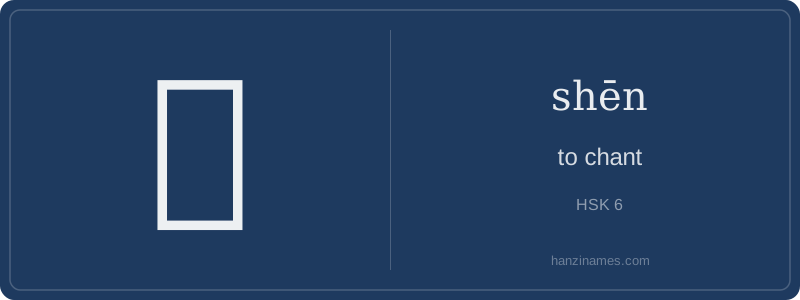
In contemporary Chinese, 呻 is rarely used alone in daily speech; instead, it appears almost exclusively in classical or literary compounds like 呻吟 (shēnyín, 'to moan'—though this usage developed later) or in historical/medical contexts. Its most documented real-world usage is in traditional Chinese medicine texts and Daoist ritual manuals, where 呻 refers to prescribed vocalizations aligned with organ systems—e.g., the 'Heart Sound' (心音) chanted as 呻 to regulate fire energy. Modern dictionaries (e.g., Xiandai Hanyu Cidian, 7th ed.) list its primary meaning as 'to chant/recite rhythmically', citing examples from Song dynasty poetry commentaries.
The character’s written form has no verified oracle-bone origin; it first appears in seal script (c. 3rd century BCE). Its structure is clearly phono-semantic: 口 (mouth radical, indicating vocal action) + 申 (shēn, both phonetic and semantic—'to extend, declare'). No pictographic sun/moon/tree derivation applies here; it’s a constructed character for a specific, refined auditory practice.
Our detective work begins at the crime scene: the character 呻. At first glance, it appears to be a mouth (口) reciting something—but what? The right-hand component, 申 (shēn), is not merely decorative; it’s a phonetic clue and semantic anchor. In ancient bronzeware inscriptions, 申 resembled lightning—symbolizing extension, proclamation, or divine utterance. When fused with 口, it evolved into a character denoting deliberate vocalization: not casual speech, but rhythmic, ritualized sound.
By the Han dynasty, 呻 appears in medical texts like the Huangdi Neijing, where it describes therapeutic chanting of incantations or breathing formulas—precisely aligned with 'to intone' or 'to chant'. Its eight-stroke structure is deceptively simple: 口 (3 strokes) + 申 (5 strokes), yet each stroke follows strict orthographic rules. The final horizontal stroke of 申 must extend fully—any truncation breaks its phonetic integrity and risks confusion with similar characters like 甲 or 由.
This character never meant 'groan'—a common modern misconception stemming from homophony with 呻吟 (shēnyín), where 呻 acquired a secondary, context-driven sense of pained utterance. But historically, 呻 stands apart: it’s the voice disciplined by form, breath, and intention—whether in Daoist scripture recitation, Tang dynasty poetry chanting, or Ming-era medical qigong practice. Its HSK 6 status reflects its specialized, literary register—not everyday slang, but precise vocabulary for ritual, art, and tradition.
Example Sentences
Common Compounds
Similar Characters — Don't Mix These Up
Your First Step into Chinese Culture: Get a Chinese Name
Every journey into Chinese begins with a name. Use our free Chinese name generator to create a meaningful, personalized Chinese name that fits you perfectly.
Get My Chinese Name →