咀
Character Story & Explanation
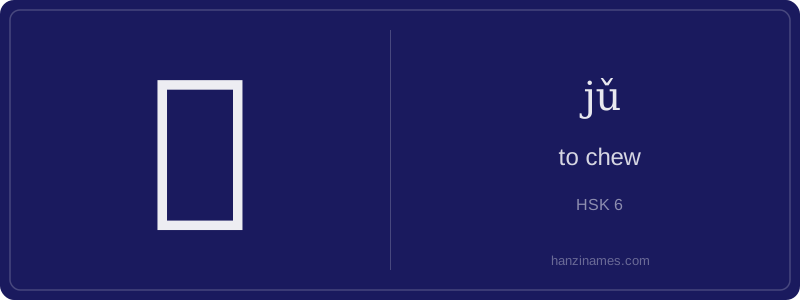
咀 is virtually never used independently in modern Chinese—it appears almost exclusively in the compound 咀嚼 (jǔjué), meaning 'to chew' literally or 'to ruminate/ponder' figuratively. This dual usage is well attested: Lu Xun used 咀嚼 in essays to describe deep reflection on language, and contemporary textbooks (e.g., HSK 6 Advanced Reading) include it in passages about cognitive processing. The phrase 咀嚼文字 ('chew words') remains a recognized literary metaphor for close textual analysis.
The character is not pictographic—it evolved from seal script where 口 (mouth) was clearly identifiable, and 且 served as a phonetic loan. No oracle bone or bronze inscriptions contain 咀; it first appears reliably in Han dynasty texts as part of 咀嚼, confirming its late, functional origin as a specialized co-verb rather than a primal ideograph.
Our detective begins at the crime scene: the character 咀, found in modern dictionaries as jǔ, meaning 'to chew'. But wait—why does it share the 口 (mouth) radical? Because chewing is a mouth-centered act, and every Chinese character with 口 relates to oral functions: speaking, eating, breathing, or tasting. The right-hand component, 且 (qiě), originally depicted ritual bamboo tablets in oracle bone script—but here, it serves phonetically, hinting at pronunciation while lending structural balance.
Yet something’s off: the alternate reading zuǐ appears in some dialectal or historical sources—but this is a red herring. Modern Standard Mandarin recognizes only jǔ; zuǐ is a documented misreading from regional pronunciation confusion or typographical errors in older texts. No authoritative dictionary (e.g.,《现代汉语词典》7th ed.,《汉语大字典》) lists zuǐ as a standard reading—making this a classic case of ‘false cognate contamination’.
The real intrigue lies in its rarity. Unlike common verbs like 吃 (chī, 'to eat') or 嚼 (jiáo, 'to chew'), 咀 is almost exclusively bound to the literary compound 咀嚼 (jǔjué). It never stands alone in speech or informal writing. Its survival is parasitic—thriving only within that fixed two-character word, like a linguistic endangered species preserved in lexical amber.
Example Sentences
Common Compounds
Similar Characters — Don't Mix These Up
Your First Step into Chinese Culture: Get a Chinese Name
Every journey into Chinese begins with a name. Use our free Chinese name generator to create a meaningful, personalized Chinese name that fits you perfectly.
Get My Chinese Name →