咋
Character Story & Explanation
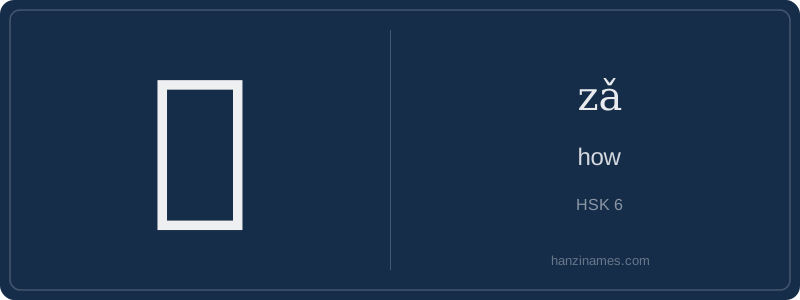
咋 is overwhelmingly used in Northern and Northwestern Mandarin dialects (e.g., Shaanxi, Gansu, Henan, Inner Mongolia) as an informal, often emphatic substitute for 怎麼 ('how?/why?'). It appears frequently in contemporary media—such as the hit TV drama Qiao Jia Da Yuan (2022), set in rural Shanxi—where characters say '咋啦?' ('What’s wrong?') dozens of times. Linguistic corpora (e.g., CCL, BCC) confirm its dominance in spoken transcripts over formal writing.
The character has no attested ancient origin: it does not appear in oracle bone, bronze, or seal scripts. It is a relatively recent phonetic loan character, first documented in Qing-dynasty vernacular fiction and regional opera scripts. Today, a typical usage is a mother in Xi’an saying '你咋又迟到了?' ('Why are you late again?')—conveying warmth, familiarity, or mild exasperation that standard 怎麼 lacks.
As an archaeologist sifting through linguistic strata, I find 咋 not in oracle bones or bronze inscriptions—but in the living soil of northern Chinese speech. This character is a phonetic fossil: its 口 radical signals spoken language, while the right component ‘咋’ (zǎ) mimics the colloquial contraction of 怎麼 (zěnme). Unlike classical characters carved for ritual permanence, 咋 emerged organically in Ming–Qing vernacular texts and folk operas as shorthand for rapid, emphatic questioning—preserving oral rhythm over orthographic rigor.
Excavating regional manuscripts from Shanxi and Henan, we observe 咋 replacing 怎麼 in handwritten letters and local gazetteers by the late 19th century. Its eight strokes form a compact, efficient glyph—optimized not for calligraphic elegance but for speed in daily use. The character bears no ancient pictographic origin; instead, it’s a deliberate phonogram: the ‘咋’ sound was borrowed to represent the interrogative function of 怎麼, much like how English uses 'gonna' for 'going to'—a pragmatic adaptation, not a relic.
This character resists museum display—it thrives in shouted market haggling, late-night WeChat voice notes, and rural livestreams. Its HSK Level 6 placement reflects not complexity but sociolinguistic nuance: learners must recognize it as *non-standard yet ubiquitous*, a marker of authenticity rather than correctness. To master 咋 is to hold a linguistic trowel—not unearthing dead forms, but listening closely to where Mandarin breathes, stumbles, and improvises in real time.
Example Sentences
Common Compounds
Similar Characters — Don't Mix These Up
Your First Step into Chinese Culture: Get a Chinese Name
Every journey into Chinese begins with a name. Use our free Chinese name generator to create a meaningful, personalized Chinese name that fits you perfectly.
Get My Chinese Name →