咽
Character Story & Explanation
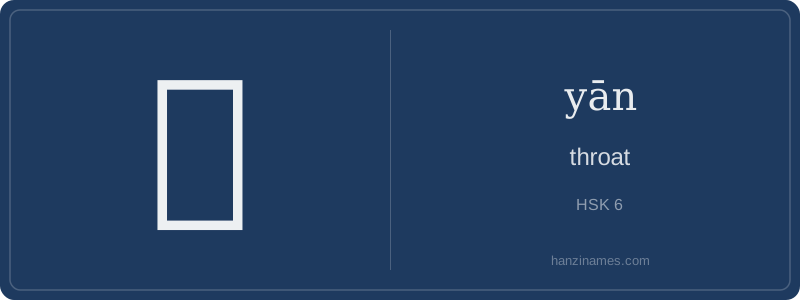
咽 appears in foundational medical texts like the *Huangdi Neijing* (circa 3rd century BCE–1st century CE), where it denotes the anatomical 'pharynx' as part of the 'Triple Burner' system. In daily use, it’s essential in compound words like 咽喉 (yānhóu, 'throat') — frequently used in health warnings ('protect your throat') and political metaphors ('a throat choked by censorship'). The idiom 咽苦吐甘 (yàn kǔ tǔ gān, 'swallow bitterness, spit sweetness') appears in Ming-dynasty literature, describing self-sacrificing forbearance.
咽 is not a pictograph — no ancient form depicts a literal throat. Instead, it’s a phono-semantic compound: 口 signals oral function; 因 provides phonetic approximation. Today, Chinese speakers commonly type 'yan' in pinyin input and select 咽 from candidates when writing medical reports, singing tutorials (e.g., 'throat placement'), or describing emotional suppression — like swallowing sobs during a funeral.
Our detective begins at the crime scene: the character 咽. Its radical 口 (mouth) is unmistakable — a clear clue pointing to oral functions. The right component, 因 (yīn), originally meant 'to rest upon' or 'cause', but here it serves phonetically, hinting at the ancient pronunciation *qin* or *ʔen*, later evolving into yān/yè/yàn. This dual role — semantic mouth + phonetic anchor — is classic for Chinese phono-semantic compounds, first standardized in seal script during the Qin dynasty.
Three pronunciations tell three stories: yān (anatomical, neutral tone) denotes the physical throat; yè (fourth tone) captures the choked, sobbing swallow — think of suppressed tears; yàn (fourth tone, stronger) is the active, muscular act: swallowing food or pride. These tonal shifts aren’t arbitrary; they reflect functional differentiation documented in the *Shuōwén Jiězì* (121 CE), China’s first dictionary, which classifies 咽 under 口 and defines it as 'the passage for food and breath.'
The character’s evolution reveals linguistic forensics in action. No oracle bone inscriptions of 咽 survive — it likely emerged later, as medical and physiological vocabulary expanded with Warring States–era texts like the *Huangdi Neijing*. Its consistent 9-stroke structure across clerical, regular, and modern scripts shows remarkable stability. That stability belies its semantic agility: one grapheme mapping anatomy, physiology, and emotion — a rare triad in Chinese orthography, making it a high-level (HSK 6) challenge not due to rarity, but precision.
Example Sentences
Common Compounds
Similar Characters — Don't Mix These Up
Your First Step into Chinese Culture: Get a Chinese Name
Every journey into Chinese begins with a name. Use our free Chinese name generator to create a meaningful, personalized Chinese name that fits you perfectly.
Get My Chinese Name →