哀
Character Story & Explanation
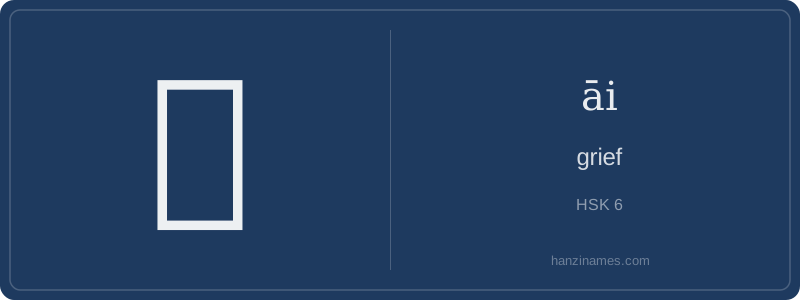
In daily life, 哀 appears mainly in formal, literary, or ritual contexts: mourning notices (讣告 fùgào), memorial couplets (挽联 wǎnlián), and idioms like 哀鸿遍野 (āi hóng biàn yě, 'cries of wild geese fill the land'—metaphor for widespread suffering). It is rare in casual speech; native speakers more often use 伤心 (shāngxīn) or 悲伤 (bēishāng) for everyday sorrow. The HSK 6 placement reflects its low-frequency, high-register usage.
The character’s seal script form shows 口 (mouth) + 衣 (clothing), historically interpreted as 'voice clothed in grief'—a documented semantic-phonetic compound (形声字 xíngshēngzì) where 衣 serves phonetically (ancient pronunciation approx. *ʔəj*). No oracle-bone evidence exists for 哀; its earliest attestation is in Warring States bamboo slips, consistently meaning 'to mourn'.
The character 哀 (āi) primarily means 'grief', 'sorrow', or 'mourning' in modern standard Chinese. It conveys deep, solemn emotion—often associated with loss, bereavement, or reverence for the departed. Unlike casual sadness (e.g., 难过 nánguò), 哀 carries ritual weight and literary gravity, appearing in classical texts, funeral rites, and formal elegies. Its tone is restrained yet profound, evoking Confucian ideals of respectful mourning and emotional sincerity.
Historically, 哀 was also used as a personal name—most notably for Ai (哀), the sixth legendary Flame Emperor (Yandi 炎帝) descended from Shennong 神農. This usage reflects ancient naming conventions where characters denoting virtue or cosmic resonance were adopted by rulers. However, this proper noun sense is archaic and appears almost exclusively in historiographical texts like the Shiji (Records of the Grand Historian) and later commentaries—not in spoken language or modern naming.
In Western cultural comparison, 哀 aligns most closely with the Greek concept of *penthos*—ritualized grief expressed through lamentation, public mourning, and ethical restraint—as seen in Greek tragedies and Homeric epics. It differs from English 'sadness' (too generic) or 'sorrow' (closer but less ceremonial). Like Latin *luctus*, 哀 implies socially sanctioned, embodied mourning—wearing white, abstaining from celebration, and honoring ancestral duty—rather than private psychological states emphasized in modern Western psychology.
Example Sentences
Common Compounds
Similar Characters — Don't Mix These Up
Your First Step into Chinese Culture: Get a Chinese Name
Every journey into Chinese begins with a name. Use our free Chinese name generator to create a meaningful, personalized Chinese name that fits you perfectly.
Get My Chinese Name →