哄
Character Story & Explanation
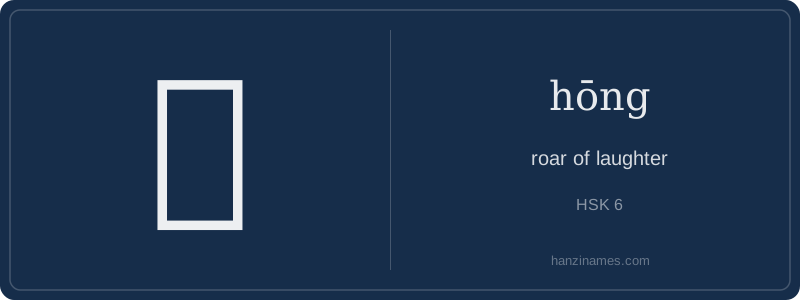
In modern Mandarin, 哄 most commonly appears in spoken contexts denoting collective vocal reactions: 哄堂大笑 (hōng táng dà xiào, 'roar of laughter filling the hall') is a standard HSK-6 idiom used in textbooks, news reports, and formal speeches to describe contagious, unrestrained group mirth — notably in courtrooms, lecture halls, or comedy performances. It also appears in historical records like the Ming Dynasty Vernacular Stories describing bustling teahouses where 'crowds hōnged with laughter' at storytellers.
The character is a phono-semantic compound: 口 (kǒu, mouth) is the semantic radical indicating speech/sound; 轰 (hōng) is the phonetic component, itself derived from the ancient pictograph for thunder (three 'vehicles' 車 stacked to suggest repeated, rumbling motion). No oracle-bone form exists — it first appeared in Song-era printed texts as a variant for 轟, later specializing in vocal resonance.
The character 哄 (hōng) opens a window into the Chinese cultural understanding of collective emotion — not as private feeling, but as resonant, embodied sound. Its radical 口 (mouth) signals vocalization, while the phonetic component 轰 (hōng, 'to boom') evokes mass resonance: laughter that shakes walls, not just smiles. In Chinese worldview, joy gains legitimacy and power when shared audibly — a roar is more authentic than a whisper.
This tri-pronunciation character (hōng/hǒng/hòng) reflects linguistic pragmatism: one grapheme adapts to context like water — shifting from communal mirth (hōng), to coaxing a child (hǒng), to chaotic clamor (hòng). Such polysemy isn’t ambiguity; it’s efficiency, mirroring Confucian emphasis on relational meaning over fixed definitions.
Historically, 哄 appears in Ming-Qing vernacular fiction describing marketplace bustle or opera audiences roaring with delight — never solitary chuckles. The ‘roar of laughter’ is thus culturally coded as social glue: laughter that synchronizes breath, rhythm, and identity. To ‘hōng’ is to participate in harmony through sound — a sonic counterpart to the Confucian ideal of 和 (harmony).
Example Sentences
Common Compounds
Similar Characters — Don't Mix These Up
Your First Step into Chinese Culture: Get a Chinese Name
Every journey into Chinese begins with a name. Use our free Chinese name generator to create a meaningful, personalized Chinese name that fits you perfectly.
Get My Chinese Name →