哇
Character Story & Explanation
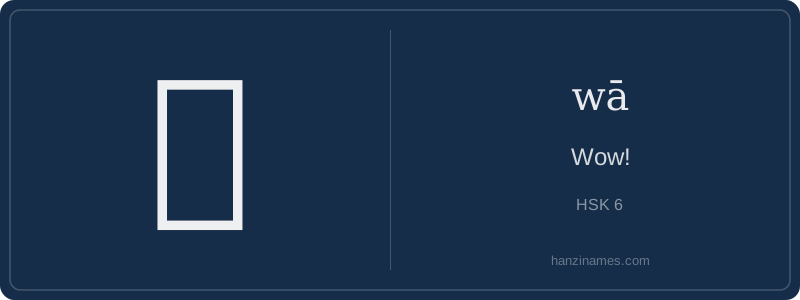
哇 is overwhelmingly used today as an oral interjection in casual speech, digital communication, and entertainment media. It appears frequently in subtitles of variety shows (e.g., *The Rap of China*), WeChat chats, and Douyin comments — often repeated for emphasis (e.g., 哇哇哇!). No classical idiom or fixed phrase features 哇; it’s absent from pre-modern literary texts, confirming its modern colloquial origin. Linguists classify it as a phonetic loan character adopted purely for sound, not meaning.
The character combines 口 (mouth radical, indicating speech) with 华 (huá, originally meaning 'splendor' but here serving only as a phonetic component). This is a standard phono-semantic compound — the 口 hints at vocalization, while 华 provides approximate pronunciation (wā approximates the older *hua* reading in some dialects). There is no pictographic origin; it emerged in vernacular writing during the 20th century to transcribe spontaneous speech.
哇 (wā) is an interjection expressing sudden surprise, admiration, or delight — equivalent to 'Wow!' or 'Whoa!' in English. Unlike formal vocabulary, it carries strong emotional tone and is almost exclusively used in spoken or informal written contexts like social media, text messages, or dialogue in novels and subtitles. Its pronunciation is a sharp, open-mouthed exclamation, with the first tone emphasizing immediacy and authenticity.
This character belongs to the 口 (mouth) radical family, signaling its vocal, expressive nature. Though it appears in HSK Level 6 — the highest proficiency tier — it’s not a high-frequency academic word but rather a pragmatic marker of native-like fluency and emotional nuance. Learners often encounter it late because mastery involves recognizing context-dependent intonation shifts, not just memorization.
Culturally, 哇 functions similarly to English ‘Wow!’ but with greater flexibility: it can soften criticism ('哇,这价格…' — 'Wow, this price…'), express ironic disbelief, or even serve as a polite filler to acknowledge others’ statements. Unlike Western exclamations that may imply superficiality, 哇 in Chinese often signals genuine, unfiltered reaction — especially among younger generations using it playfully in memes and livestream comments.
Example Sentences
Common Compounds
Similar Characters — Don't Mix These Up
Your First Step into Chinese Culture: Get a Chinese Name
Every journey into Chinese begins with a name. Use our free Chinese name generator to create a meaningful, personalized Chinese name that fits you perfectly.
Get My Chinese Name →