哦
Character Story & Explanation
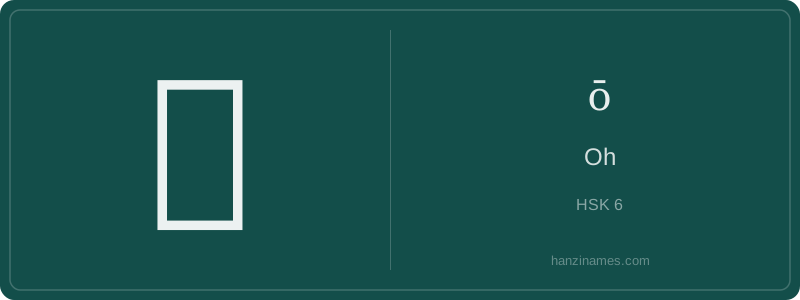
哦 is ubiquitous in spoken and written Mandarin as a discourse particle—especially in informal writing (text messages, social media, dialogue in novels) and oral communication. It appears frequently in contemporary literature (e.g., Lu Xun’s dialogues use variants like ‘噢’ and ‘哦’ to mark shifts in speaker attitude) and is documented in linguistic corpora like the Beijing Language and Culture University’s CCL Corpus as one of the top five interjections in spontaneous speech.
The character has no ancient pictographic origin—it’s a relatively late phonetic loan character, first appearing consistently in Qing dynasty vernacular texts. Its form derives from the phonetic borrowing of 我 (wǒ) for sound, paired with 口 to signal orality. Today, Chinese speakers instinctively adjust its tone and length in real time: a drawn-out 'ō——' after hearing surprising news, or a clipped 'ò' when conceding a point in argument.
Our detective begins at the scene: the character 哦 appears in modern printed and digital Chinese as a vocalized pause—a linguistic fingerprint of sudden comprehension. Unlike lexical characters, it belongs to the class of *interjectional phonograms*: its form doesn’t encode meaning pictorially but signals speech rhythm and attitude. Its radical 口 (mouth) anchors it firmly in the domain of spoken expression—every stroke echoes articulation, not abstraction.
Zooming in on its structure: 哦 combines 口 (radical, 3 strokes) with 我 (wǒ, 'I', 7 strokes), making 10 strokes total. This is not semantic compounding—'mouth + I' doesn’t mean 'I speak'. Rather, 我 here functions purely as a *phonetic component*, approximating the sound ō/ó/ò. Historical dictionaries like the *Kangxi Zidian* (1716) list it under 口, confirming its role as a vocal marker—not a noun or verb.
The tonal variations tell a pragmatic story: ō (high level) signals calm realization; ó (rising) adds surprise or gentle protest; ò (falling) conveys reluctant acceptance or soft skepticism. These aren’t dialectal quirks—they’re documented prosodic tools used across Mandarin-speaking regions, codified in the *Modern Chinese Dictionary* (7th ed., 2016). No ancient oracle bone or bronze inscription bears 哦—it emerged late, likely during the Ming–Qing vernacular fiction boom, when writers needed written equivalents for conversational intonation.
Example Sentences
Common Compounds
Similar Characters — Don't Mix These Up
Your First Step into Chinese Culture: Get a Chinese Name
Every journey into Chinese begins with a name. Use our free Chinese name generator to create a meaningful, personalized Chinese name that fits you perfectly.
Get My Chinese Name →