哨
Character Story & Explanation
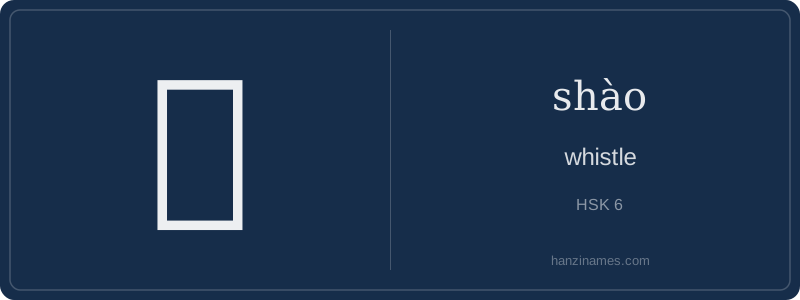
哨 has been used for centuries in Chinese military and civilian life as both a verb ('to whistle') and a noun ('a whistle' or 'a哨 post'). In Ming and Qing dynasties, border garrisons employed 哨兵 (sentinels) who used bamboo or metal whistles to relay warnings across mountain passes — documented in military manuals like the Bingfa Jiyao. Today, it appears in standard phrases like 拉响警报 (lā xiǎng jǐngbào, 'to sound the alarm') and in idioms like 明察暗访 (míngchá ànfǎng), where 哨 can colloquially refer to undercover surveillance ('sending out scouts').
The character is not pictographic; its earliest forms (seal script, c. 3rd century BCE) show 口 + 少 — a semantic-phonetic compound, not a drawing of a whistle. In daily life, modern Chinese use 哨 most commonly when describing sports referees blowing whistles, school PE teachers giving commands, or parents playfully whistling to get a child’s attention — all real, frequent, audible moments.
Hello students! The character 哨 (shào) is a great example of how Chinese characters combine meaning and sound. Its radical 口 (kǒu, 'mouth') tells us it’s related to speech, sound, or oral action — like whistling, calling, or blowing. The right side 少 (shǎo, 'few') isn’t just decorative: it gives the pronunciation clue (shào sounds close to shǎo), and historically, 'few' may hint at the short, sharp, brief nature of a whistle — one quick burst of sound, not a long phrase.
Don’t confuse 哨 with other mouth-related characters like 吹 (chuī, 'to blow') or 叫 (jiào, 'to shout'). 哨 specifically implies a high-pitched, controlled, often piercing sound made with lips or a device. It’s not casual noise — it’s intentional signaling. Think of a lifeguard’s sharp blast, a referee’s call, or soldiers using coded whistles during drills. That precision is built into the character’s design and usage.
At HSK Level 6, 哨 appears in more advanced vocabulary like 哨兵 (shàobīng, 'sentry') and 哨所 (shàosuǒ, 'outpost'), where the whistle evolves metaphorically into 'vigilance' and 'alertness'. This shift from physical sound to symbolic watchfulness shows how deeply sound-based actions are woven into Chinese military and social culture. Learning 哨 opens a door not just to vocabulary, but to understanding how auditory signals shape communication and authority in Chinese contexts.
Example Sentences
Common Compounds
Similar Characters — Don't Mix These Up
Your First Step into Chinese Culture: Get a Chinese Name
Every journey into Chinese begins with a name. Use our free Chinese name generator to create a meaningful, personalized Chinese name that fits you perfectly.
Get My Chinese Name →