唆
Character Story & Explanation
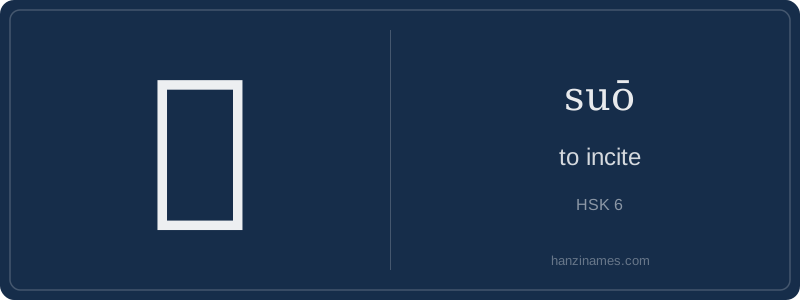
唆 is commonly used in formal and media contexts to assign culpability—for example, in news reports accusing individuals of '唆使他人行骗' (inciting others to commit fraud) or judicial documents citing '唆使未成年人犯罪' (instigating minors to commit crimes). A well-documented phrase is 唆使 (suōshǐ), appearing in China’s Criminal Law Article 29, which defines liability for instigators. It also appears in historical vernacular fiction like *The Scholars* (Rulin Waishi, 18th c.), where characters are criticized for 唆人争讼 (inciting lawsuits).
The character’s form is phono-semantic: 口 (kǒu, 'mouth') as radical signals speech-related meaning, while 夋 (qūn, now archaic) serves as the phonetic component—though its pronunciation diverged over time (from *sruːɡ in Middle Chinese to suō today). No oracle-bone or bronze script forms survive; it first appears in Song dynasty dictionaries as a colloquial verb, reflecting its origin in spoken language rather than ancient ritual texts.
The Chinese character 唆 (suō) conveys the act of deliberately provoking or urging someone—often covertly or manipulatively—to take harmful, reckless, or unethical action. Unlike neutral verbs like 'suggest' or 'encourage', 唆 carries strong negative moral weight, implying culpability and intent to exploit another’s weakness. It appears most frequently in legal, journalistic, and literary contexts where responsibility for misconduct must be assigned—not just to the doer, but to the instigator behind the scenes.
In Western cultural frameworks, comparable concepts include 'incitement' (a legal term in U.S. and UK law, e.g., inciting violence), 'goading' (emphasizing emotional provocation), or Shakespearean 'whispering poison into the ear'—as seen with Iago in *Othello*. Yet 唆 is more concise and lexicalized than these English phrases; it functions as a standalone verb with built-in judgment, not requiring modifiers like 'maliciously' to signal wrongdoing.
Historically, 唆 reflects Confucian ethical concern with moral influence: one’s words carry social consequence, and guiding others toward harm violates the principle of *ren* (benevolence). In modern usage, it’s often paired with agents like 'bad elements' (坏人) or 'hostile forces' (敌对势力) in official discourse, underscoring its role in assigning ideological responsibility. This contrasts with Western individualist framing, where 'instigation' may be legally actionable but rarely embedded so deeply in everyday moral vocabulary.
Example Sentences
Common Compounds
Similar Characters — Don't Mix These Up
Your First Step into Chinese Culture: Get a Chinese Name
Every journey into Chinese begins with a name. Use our free Chinese name generator to create a meaningful, personalized Chinese name that fits you perfectly.
Get My Chinese Name →