唇
Character Story & Explanation
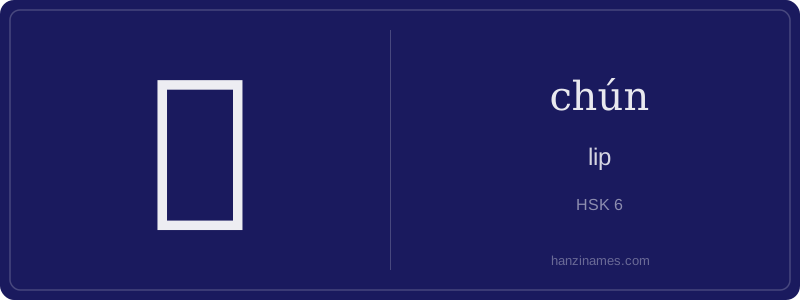
In modern Chinese, 唇 appears most frequently in formal, medical, or literary contexts—not daily chit-chat. You’ll find it in terms like 唇语 (chún yǔ, 'lip-reading'), 唇膏 (chún gāo, 'lipstick'), and the idiom 唇亡齿寒 (chún wáng chǐ hán, 'when the lips are gone, the teeth feel the cold'—a Warring States-era metaphor for interdependence, first recorded in the *Zuo Zhuan*). It’s also standard in anatomy textbooks and health advisories (e.g., 唇裂, cleft lip).
The character’s earliest verifiable form is in Qin dynasty bamboo slips and Han dynasty seals, showing the familiar 口 + 純 structure—no earlier pictograph exists. So rather than tracing an ancient drawing of lips, we observe how contemporary speakers use it: a doctor writes 唇色苍白 (chún sè cāngbái, 'pale lip color') in a clinical note; a makeup influencer tags #唇妆 (chún zhuāng, 'lip makeup') on Xiaohongshu.
Our detective work begins with the oracle-bone and bronze inscriptions—but here, the trail goes cold: 唷 (chún) has no confirmed pre-Qin pictographic form. Unlike ‘mouth’ (口) or ‘eye’ (目), which clearly mirror anatomy, 唇 emerged later in seal script (c. 3rd century BCE), already as a compound character. Its structure—left radical 口 (mouth) and right phonetic component 純 (chún, 'pure')—suggests a phonosemantic construction, not a pictograph. This tells us ancient scribes prioritized sound and semantic association over visual depiction for this anatomical term.
Zooming in on the components: 口 anchors it to speech, ingestion, and oral expression—logical for lips, the gatekeepers of voice and taste. The right side, 純, was borrowed purely for its pronunciation (chún), though its original meaning ('unadulterated') may subtly reinforce cultural associations of lips with sincerity or unfiltered expression—think of phrases like 'lips don’t lie' in Chinese discourse. No evidence suggests 純 was chosen for symbolic resonance; it’s primarily a phonetic placeholder, yet meaning echoes persist.
The character stabilized in clerical script during the Han dynasty and has remained virtually unchanged for over two millennia. Its ten-stroke form reflects meticulous balance: four strokes for 口 (enclosing space), six for 純 (with its three horizontal lines and flowing final stroke). Modern typefaces preserve this symmetry—a testament to orthographic conservatism. While rarely used alone today, 唇 thrives inside compounds and literary registers, where precision matters more than frequency. Its endurance reveals how Chinese writing preserves functional morphology across centuries, even for subtle body parts.
Example Sentences
Common Compounds
Similar Characters — Don't Mix These Up
Your First Step into Chinese Culture: Get a Chinese Name
Every journey into Chinese begins with a name. Use our free Chinese name generator to create a meaningful, personalized Chinese name that fits you perfectly.
Get My Chinese Name →