唐
Character Story & Explanation
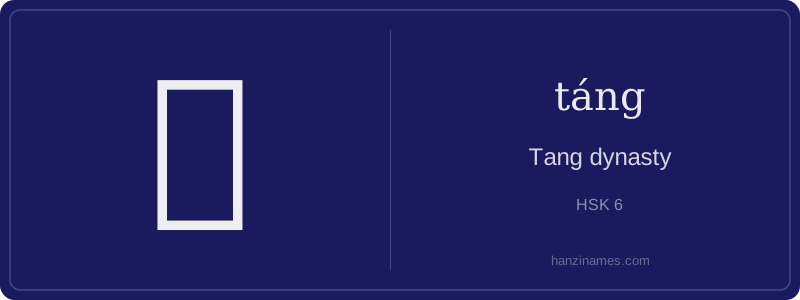
In modern Chinese, 唐 most commonly appears in historical, cultural, and diasporic contexts: ‘Tang dynasty’ (唐朝), ‘Tang costume’ (唐装), and ‘Chinatown’ (唐人街)—a term documented as early as the Qing dynasty and still used officially in cities like San Francisco and Kuala Lumpur. It also appears in idioms like 唐突 (tángtū, 'rude/abrupt'), derived from the literary sense of 'out of place', reflecting Tang-era stylistic norms.
The character’s earliest attested form appears in seal script (c. 3rd century BCE), where it depicts a fortified settlement with a mouth-like gate—consistent with its original meaning 'to enclose' or 'a walled city'. While its phonetic component 康 (kāng) suggests pronunciation, scholars agree the 口 radical reflects administrative or declarative function—not speech per se, but official proclamation.
As an archaeologist brushing dust from a Tang-era stele in Xi’an, I first encountered 唐 not as a word—but as a resonance. Carved into stone and inked onto silk sutras, it carried the weight of cosmopolitan Chang’an: Persian merchants in wine shops, Japanese envoys studying Confucian classics, and poets like Li Bai composing under moonlight. Its presence signals more than chronology—it marks a golden standard of cultural flourishing, governance, and artistic synthesis that later dynasties measured themselves against.
The character’s ten strokes—beginning with the 口 (mouth) radical—hint at proclamation and authority. In Tang legal inscriptions and imperial edicts, 唐 wasn’t just a name; it was a performative utterance, declaring legitimacy and celestial mandate. Excavated wooden slips from Dunhuang show scribes carefully writing 唐 in clerical script to date tax records and monastic inventories—proof that this character anchored time, administration, and identity across empire.
Modern excavations reveal how deeply 唐 permeated material culture: ceramic shards stamped with 唐, bronze mirrors engraved with ‘Tang virtue’, and even Central Asian textiles bearing stylized 唐 motifs traded along the Silk Road. It functioned less as a mere dynastic label and more as a civilizational brand—so potent that overseas communities adopted ‘Tang’ for centuries (e.g., Chinatowns called 唐人街). To uncover 唐 is to unearth not just a dynasty, but a linguistic artifact of enduring soft power.
Example Sentences
Common Compounds
Similar Characters — Don't Mix These Up
Your First Step into Chinese Culture: Get a Chinese Name
Every journey into Chinese begins with a name. Use our free Chinese name generator to create a meaningful, personalized Chinese name that fits you perfectly.
Get My Chinese Name →