唾
Character Story & Explanation
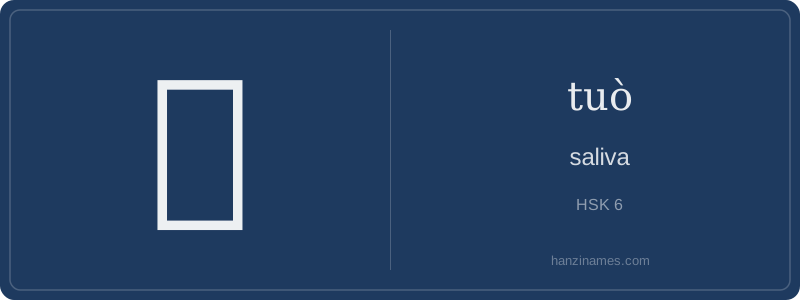
唾 is rarely used alone in modern speech but appears in fixed expressions conveying contempt or physiological precision. The idiom 唾手可得 (tuò shǒu kě dé, 'obtainable by spitting on one’s hand')—originally meaning 'effortlessly attainable'—is still taught in textbooks and appears in formal writing. In historical medical contexts, 唾 was classified as one of the 'five fluids' (五液) linked to the spleen, per *Suwen* (c. 2nd century BCE). It also features in Tang-dynasty poetry describing disdainful dismissal.
The character is not a pictograph—it has no oracle-bone or bronze-inscription form depicting saliva. Instead, it emerged during the Warring States period as a phono-semantic compound: 口 (mouth) + 垂 (phonetic, chuí → tuò). Today, Chinese learners most commonly encounter it in idioms or when studying TCM terminology—not in conversation, but in reading comprehension exams and classical annotation exercises.
Our detective begins at the crime scene: the character 唾, found in texts dating back to the Warring States period. Its left side 口 (kǒu, 'mouth') is the clear suspect—the radical always signals oral or vocal activity. The right component, 垂 (chuí), originally depicted drooping hair or flowing water in oracle-bone script; by the Han dynasty, it had phonetically stabilized as a sound hint for tuò—confirming this is a phono-semantic compound, not a pictograph of saliva itself.
Zooming in on 垂: its ancient form showed strands descending vertically—evoking liquid dripping from the mouth. Over centuries, calligraphic simplification smoothed its curves, but the semantic echo remains: saliva *falls* or *drips* from the mouth. No early inscriptions show a literal spit-drop glyph; instead, scribes relied on association—mouth + downward flow = saliva in motion. This reflects classical Chinese’s preference for conceptual logic over direct depiction.
The character’s rarity in daily speech today doesn’t diminish its forensic value. In medical texts like the *Huangdi Neijing*, 唾 appears alongside 涎 (xián, 'drool') and 涕 (tì, 'nasal mucus'), classifying bodily fluids by origin and function. Its HSK 6 status confirms it’s reserved for advanced learners—not because it’s obscure, but because it surfaces precisely where nuance matters: classical idioms, literary scorn, and traditional medicine—never in casual 'I’m thirsty' talk.
Example Sentences
Common Compounds
Similar Characters — Don't Mix These Up
Your First Step into Chinese Culture: Get a Chinese Name
Every journey into Chinese begins with a name. Use our free Chinese name generator to create a meaningful, personalized Chinese name that fits you perfectly.
Get My Chinese Name →