啥
Character Story & Explanation
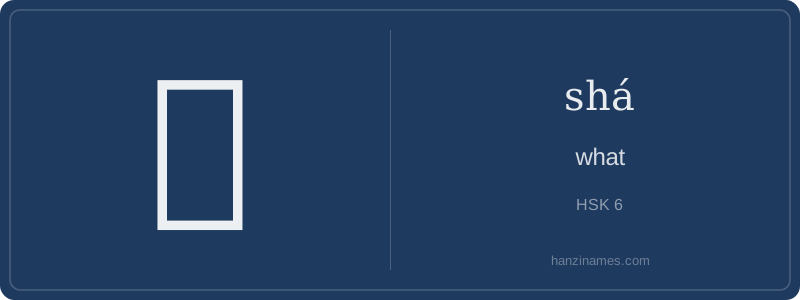
啥 is widely documented in modern Mandarin vernacular since the early 1900s, especially in Beijing and Northeastern dialects. It appears frequently in Lu Xun’s dialogues (e.g., *The True Story of Ah Q*), modern TV dramas (*I Am Not an Easy-going Person*), and social media comments—always marking informality or regional identity. Though not in classical texts, it’s codified in the *Contemporary Chinese Dictionary* (7th ed., 2016) as a colloquial variant of 什麼. No fixed idioms feature 啥 alone, but it’s ubiquitous in spoken set phrases like ‘有啥说啥’ (yǒu shá shuō shá, 'say whatever you have').
The character 啥 is a phono-semantic compound: 口 (kǒu, ‘mouth’, radical) + 奢 (shē, ‘luxury’, here serving phonetically). Its form dates to at least the Qing dynasty, appearing in vernacular novels and folk scripts as a shorthand for rapid pronunciation. Unlike ancient pictographs, 啥 has no oracle-bone or bronze script origin—it emerged organically from speech simplification, not ancient symbolism.
啥 (shá) is a colloquial, dialect-influenced contraction of 什麼 (shénme), meaning 'what'. It appears overwhelmingly in informal spoken Mandarin—especially in Northern China—and carries a relaxed, sometimes teasing or impatient tone. Unlike formal written contexts where 什麼 is required, 啥 thrives in dialogue: chats with friends, street vendors haggling, or parents playfully scolding kids. Its use signals authenticity and regional flavor, making it essential for learners aiming to sound natural in everyday conversation.
This character’s informality doesn’t mean it’s ungrammatical—it follows standard question syntax but replaces the two-syllable 什麼 with one brisk syllable. Native speakers often drop the tone mark in casual writing (e.g., text messages or subtitles), though officially it’s third tone (shǎ). Linguists note its rise correlates with 20th-century Beijing opera and radio broadcasting, where rapid speech favored phonetic reduction. It’s rarely used in official documents, news reports, or academic writing.
While 啥 isn’t in the HSK 1–5 lists, its inclusion at HSK 6 reflects its role in advanced listening comprehension—especially in authentic audio materials like sitcoms, vlogs, or interviews. Learners often first hear it in phrases like ‘你吃啥?’ (Nǐ chī shá?) before recognizing it as ‘what’. Mastering 啥 means grasping not just vocabulary, but sociolinguistic nuance: when to use it (with peers, not your boss), how tone shifts meaning (shá vs. shà), and why it feels warmer—or cheekier—than its formal counterpart.
Example Sentences
Common Compounds
Similar Characters — Don't Mix These Up
Your First Step into Chinese Culture: Get a Chinese Name
Every journey into Chinese begins with a name. Use our free Chinese name generator to create a meaningful, personalized Chinese name that fits you perfectly.
Get My Chinese Name →