喘
Character Story & Explanation
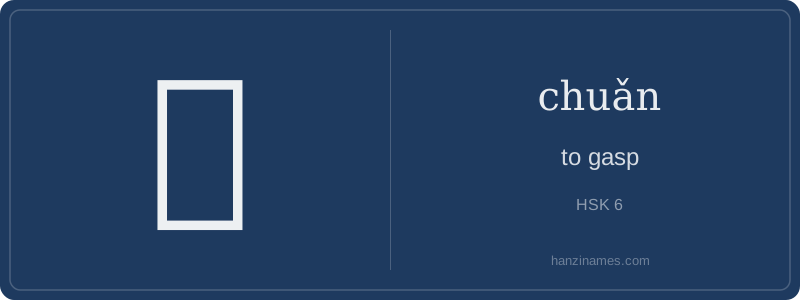
喘 is commonly used in daily Mandarin to describe audible, strained breathing—especially after exertion or in stress. It appears in standardized medical terminology (e.g., 支气管哮喘, 'bronchial asthma') and frequent idioms like 气喘吁吁 (qì chuǎn xū xū), documented in the Contemporary Chinese Dictionary (7th ed., 2016) and widely taught in HSK 6 curricula. It also features in classical poetry and modern novels to convey emotional intensity without explicit narration.
The character is a phono-semantic compound: 口 (kǒu, 'mouth') is the semantic radical indicating speech/respiration; 端 (duān) serves as the phonetic component (though pronunciation shifted from *tuān to chuǎn over time). No oracle-bone or bronze script forms survive for 喘—its earliest attested use appears in Tang dynasty texts (e.g., Bai Juyi’s poems), describing physical exhaustion and emotional agitation.
Imagine climbing the steep stone steps of Huangshan Mountain at dawn—your lungs burn, your breath hitches, and each inhalation escapes as a sharp, involuntary 'chuǎn'—the sound and sensation captured perfectly by the character 喘. Its radical 口 (mouth) anchors it in vocalized, physical respiration, while the phonetic component 端 (duān) hints at its pronunciation and subtly evokes 'upright effort'—as if the body strains upright just to draw air.
喘 is not merely biological; it’s deeply expressive in Chinese literature and speech. A gasping breath signals exhaustion, panic, relief, or even suppressed emotion—think of a tearful reunion where words fail and only 喘 remains audible. Unlike neutral verbs like 呼吸 (to breathe), 喘 carries urgency, vulnerability, and visceral presence—it’s the sound of humanity pushed to its limit.
In modern usage, 喘 appears in medical contexts (e.g., 喘息, 'wheezing'), literary descriptions ('他喘着粗气', 'He panted heavily'), and idiomatic phrases like 气喘吁吁 (qì chuǎn xū xū)—a reduplicated form emphasizing labored breathing. Its HSK 6 status reflects its nuanced, context-sensitive nature: learners must grasp not just definition, but emotional register, collocation patterns, and subtle distinctions from synonyms like 呼、吸, or 息.
Example Sentences
Common Compounds
Similar Characters — Don't Mix These Up
Your First Step into Chinese Culture: Get a Chinese Name
Every journey into Chinese begins with a name. Use our free Chinese name generator to create a meaningful, personalized Chinese name that fits you perfectly.
Get My Chinese Name →