唤
Character Story & Explanation
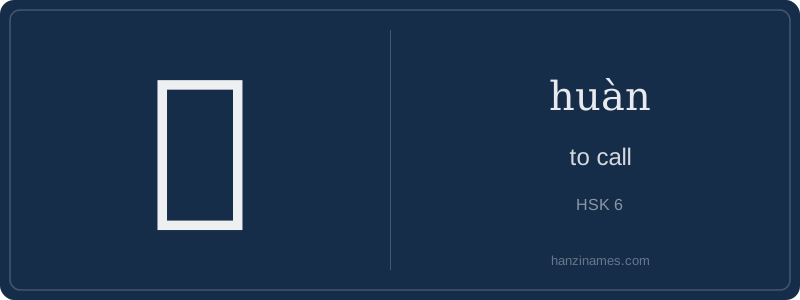
In daily life, 唤 is commonly used in compound verbs like 唤醒 (huànxǐng, 'to wake up') and 呼唤 (hūhuàn, 'to call out; to yearn for'). It appears in official contexts (e.g., government slogans: '呼唤生态文明' — 'calling for ecological civilization') and widely in media headlines. The idiom '千呼万唤' (qiān hū wàn huàn, 'a thousand calls, ten thousand summons') from Bai Juyi’s Tang-dynasty poem 'Pipa Xing' remains in active use to describe eager, repeated anticipation—documented in authoritative dictionaries like the Xiandai Hanyu Cidian.
The character is not pictographic; its form evolved from seal script. The left 口 clearly denotes oral action. The right component 幄 is a phonetic-semantic compound derived from 幄 (huàn), historically associated with 'shouting' and 'summoning'. No oracle-bone inscription of 唤 exists—its earliest verified forms appear in Warring States bamboo texts, consistently with 口 + 幄 structure.
Imagine standing in a misty courtyard of an old Beijing hutong at dawn. A grandmother leans out her wooden gate, cupping her hands around her mouth: 'Xiǎo Míng—huàn nǐ chī zǎofàn!' Her voice cuts through the quiet—not shouting, but purposefully projecting, warm and insistent. This is 售 not just sound, but intention: a call that carries care, duty, or urgency. The character’s 口 (mouth) radical grounds it in vocal action, while the right side 幄 (huàn) signals both sound and summoning—a linguistic echo of breath made meaningful.
The character 唤 appears frequently in modern Mandarin where agency matters: calling someone *to act*, not just to hear. It implies volition—'I summon you into presence or response.' Unlike passive verbs like 听 (tīng, 'to hear'), 唤 places emphasis on the caller’s will. In literature and speech, it often introduces turning points: a teacher 唤 a student to attention before revealing truth; a poet 唤 spring back after winter. Its tone (fourth, falling) mirrors this decisive energy—sharp, conclusive, resonant.
At HSK Level 6, 唤 marks fluency in nuanced verbal agency. Learners encounter it in formal writing, classical allusions, and emotionally charged dialogue. It rarely stands alone—it pairs with objects (唤人, 唤醒), abstract nouns (唤起记忆), or even metaphors (唤来春风). Mastery signals understanding not just of 'calling', but of invocation: how language can mobilize people, memory, or change. Its 10 strokes—beginning with 口’s clean square—mirror its function: structured, deliberate, human-centered communication.
Example Sentences
Common Compounds
Similar Characters — Don't Mix These Up
Your First Step into Chinese Culture: Get a Chinese Name
Every journey into Chinese begins with a name. Use our free Chinese name generator to create a meaningful, personalized Chinese name that fits you perfectly.
Get My Chinese Name →