喧
Character Story & Explanation
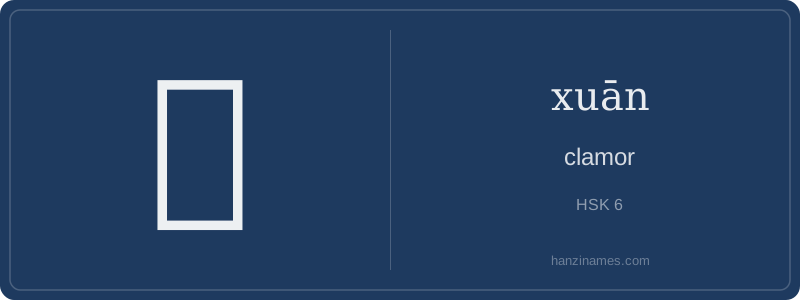
喧 is most commonly encountered in fixed two-character compounds like 喧闹 (xuān nào) and 喧哗 (xuān huá), both listed in the HSK 6 syllabus and widely used in formal writing, news reports, and literature. A documented usage appears in Lu Xun’s 1925 essay ‘The True Story of Ah Q’, where he contrasts the ‘clamor of the marketplace’ (市声喧哗) with inner silence—highlighting its longstanding role in critiquing social chaos. The term 喧宾夺主 (xuān bīn duó zhǔ, ‘the guest overshadows the host’) remains a standard idiom taught in middle schools, warning against distractions that displace what matters.
The character’s structure combines 口 (kǒu, ‘mouth’) on the left and 宣 (xuān, ‘to announce/proclaim’) on the right—a phono-semantic compound. Historical sources (e.g., Shuōwén Jiězì, 100 CE) confirm 宣 as the phonetic component and 口 as the semantic indicator, reflecting its core meaning: vocal, public, and socially resonant sound—not ambient noise, but human-generated clamor.
Imagine standing in Beijing’s Wangfujing pedestrian street at noon—vendors shout prices, tour groups chatter in ten languages, scooters whirr past, and a street musician strums loudly beside a bubbling fountain. This overwhelming sensory rush is exactly what 喧 (xuān) captures: not just sound, but the layered, unruly energy of collective human noise. It’s less about volume alone and more about the social density and chaotic liveliness that defines urban China.
Unlike generic words for ‘noise’ like 噪 (zào), 喧 carries a literary and slightly critical nuance—it often implies *unwanted* or *disruptive* clamor, especially in contrast to quietude. Classical poets used it to lament lost serenity; modern writers deploy it to critique urban alienation. Its 口 (mouth) radical signals vocal origin, while the right side 宣 (xuān, ‘to proclaim’) reinforces intentional, public utterance—not accidental sound, but voiced presence demanding attention.
In Mandarin, 喧 rarely stands alone. It appears almost exclusively in compounds like 喧闹 (xuān nào, ‘boisterous’) or 喧哗 (xuān huá, ‘uproar’), always evoking a scene where voices collide. Even in digital life, netizens use 喧 to describe ‘online clamor’—a trending Weibo topic drowning out quieter voices. This character thus maps not just acoustics, but social dynamics: who speaks, how loudly, and at whose expense.
Example Sentences
Common Compounds
Similar Characters — Don't Mix These Up
Your First Step into Chinese Culture: Get a Chinese Name
Every journey into Chinese begins with a name. Use our free Chinese name generator to create a meaningful, personalized Chinese name that fits you perfectly.
Get My Chinese Name →