丧
Character Story & Explanation
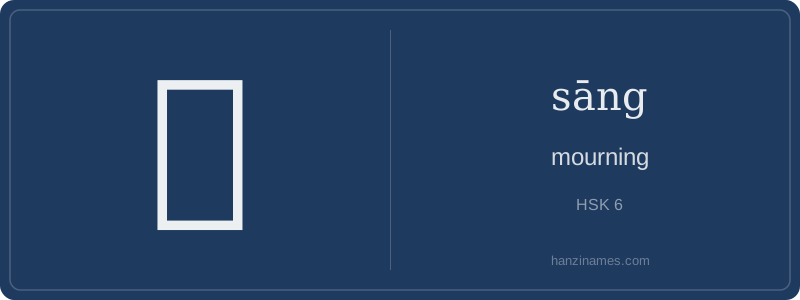
In daily life, 丧 appears most often in formal or written contexts: funeral notices (丧事, sāngshì), obituaries (讣告, fùgào), and official documents related to death. A well-known idiom is 丧尽天良 (sàng jìn tiānliáng) — literally 'lost all heavenly virtue' — used to condemn extreme moral corruption. Historically, Confucian rites prescribed detailed mourning periods based on kinship, codified in classics like the Book of Rites (礼记). These rules shaped Chinese social structure for over two millennia.
The character’s earliest attested form appears in bronze inscriptions (c. 1000 BCE), where it depicted a person kneeling beside a corpse — later simplified. By the Han dynasty, the current structure stabilized. Today, you’ll see 丧 printed on black-and-white banners at funerals, or in solemn phrases like ‘守丧’ (shǒu sāng, 'observe mourning'), still practiced in rural areas and respected in urban families during ancestral festivals.
Hi students! The character 丧 (sāng) is an important word for expressing deep sorrow and formal mourning in Chinese culture. It’s pronounced with the first tone — steady and level — like saying 'sahng' while holding your voice flat. Though it looks simple (just 8 strokes!), its meaning carries great emotional weight. In traditional Chinese society, mourning wasn’t just personal grief — it involved strict rituals, clothing (like coarse hemp garments), and family obligations lasting up to three years. That’s why 丧 appears in many formal, respectful contexts.
This character has two pronunciations: sāng (used for mourning-related nouns and terms) and sàng (a verb meaning 'to lose' or 'to perish'). Don’t mix them up! Sāng is always about death, funerals, and bereavement; sàng is more general — like losing a job or hope. You’ll see this distinction clearly in compound words and idioms. As an HSK Level 6 character, it appears in advanced reading and formal writing — not everyday chit-chat, but essential for understanding literature, news, and historical texts.
Visually, 丧 is built around the 十 (shí, 'ten') radical at the top — though historically, this part evolved from a pictograph of a person with arms raised in grief. The lower part (哭, kū, 'to cry') was simplified over time into the current form. While modern learners don’t need to memorize ancient scripts, noticing how the shape suggests sorrow helps anchor its meaning. Practice writing it slowly: start with the top cross, then the dot, then the left and right downward strokes — each one reflects solemnity and care.
Example Sentences
Common Compounds
Similar Characters — Don't Mix These Up
Your First Step into Chinese Culture: Get a Chinese Name
Every journey into Chinese begins with a name. Use our free Chinese name generator to create a meaningful, personalized Chinese name that fits you perfectly.
Get My Chinese Name →