喻
Character Story & Explanation
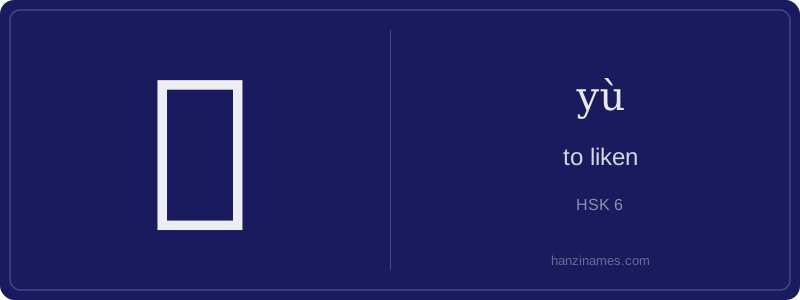
喻 appears frequently in formal contexts: news headlines ('以史为喻', yǐ shǐ wéi yù — 'using history as an analogy'), academic writing, and standardized tests like Gaokao. It’s central in idioms such as 不言而喻 (bù yán ér yù — 'so obvious it needs no explanation') and 家喻户晓 (jiā yù hù xiǎo — 'known by every family'), both attested in Song-dynasty texts and still widely used today. The character also appears in proper names (e.g., philosopher Yu Yue, 俞樾), reinforcing its scholarly resonance.
喻 is a phono-semantic compound: 口 (kǒu, 'mouth', radical) indicates speech-related meaning, while 俞 (yú, archaic phonetic component) provides sound. Though 俞 originally meant 'to agree' or 'to approve' in bronze inscriptions, its phonetic role here is well-documented in Shuōwén Jiězì (100 CE). No pictographic origin exists — it evolved as a written abstraction for rhetorical expression, not concrete depiction.
喻 (yù) is a sophisticated verb meaning 'to describe or explain something by analogy' — not merely 'to say', but to clarify through comparison, like calling life 'a journey' or time 'a river'. It carries intellectual and rhetorical weight, often appearing in formal writing, classical texts, and philosophical discourse. Unlike basic verbs like shuō (说, 'to speak'), 喻 implies intentional, skillful figurative framing — a hallmark of persuasive or literary Chinese.
In Western rhetoric, 喻 aligns closely with 'metaphor' or 'allegory' as both linguistic devices and cognitive tools. Aristotle’s concept of metaphor as 'seeing the similarity in dissimilars' mirrors the essence of 喻. Yet while English uses nouns ('metaphor') or verbs ('to liken'), 喻 functions primarily as a transitive verb requiring an explicit comparative structure (e.g., 'A 喻 B 为 C' — 'A describes B as C').
Culturally, 喻 reflects Confucian and Daoist traditions valuing indirect, image-based wisdom: the Analects rarely states truths outright but uses analogies (e.g., 'The Master said, "The wise find joy in water; the humane find joy in mountains"') — precisely the domain of 喻. Its HSK Level 6 status signals that learners need it for advanced comprehension of essays, editorials, and classical allusions — not casual speech.
Example Sentences
Common Compounds
Similar Characters — Don't Mix These Up
Your First Step into Chinese Culture: Get a Chinese Name
Every journey into Chinese begins with a name. Use our free Chinese name generator to create a meaningful, personalized Chinese name that fits you perfectly.
Get My Chinese Name →