嗦
Character Story & Explanation
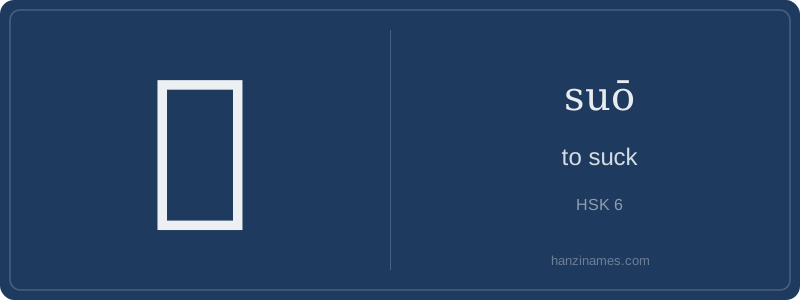
嗦 is predominantly used in informal, spoken Mandarin—especially in southwestern dialects and contemporary internet slang—to express reluctant, exaggerated, or humorous 'sucking' (literal or metaphorical). It appears in fixed expressions like 嗦一口 (suō yī kǒu, 'take a suck'), often describing sipping tea, smoking, or ironically enduring hardship. Though absent from classical texts, it’s well-documented in 20th-century folk literature and modern sitcoms (e.g., CCTV’s Home With Kids) as a character’s verbal tic signaling petulance or comic deflation.
The character is not pictographic or ancient—it’s a late-developing phono-semantic compound. The 口 radical signals oral action; 索 (suǒ) serves as the phonetic, though pronunciation shifted from suǒ to suō. No oracle bone or seal script forms exist. Today, Chinese speakers use it most commonly in phrases like ‘你嗦啥子?’ (Sichuanese: ‘What are you sucking/whining about?’), where it functions as a colloquial verb particle conveying exasperated consumption—of food, words, or nonsense.
As an archaeologist sifting through layers of linguistic sediment, I uncover 嗦 not in oracle bones or bronze inscriptions—but in the living strata of modern Mandarin speech. Its radical 口 (mouth) anchors it firmly in oral action, while the phonetic component 索 (suǒ, 'to search, to pull') hints at a visceral, drawn-out motion—like lips pulling liquid or air. This isn’t ancient ritual sucking; it’s the guttural, onomatopoeic core of colloquial vitality.
Unlike classical characters with stable semantic fields, 嗦 emerged late—first documented in Qing dynasty vernacular fiction and regional opera scripts—as a phonetic intensifier for oral actions. Its thirteen strokes form a deliberate, almost percussive shape: mouth open, tongue implied, breath controlled. The ‘sucking’ here is rarely literal; it’s performative, often exaggerated—used to convey reluctant ingestion, forced compliance, or ironic resignation.
What makes 嗦 archaeologically fascinating is its resistance to standardization. Absent from pre-20th-century dictionaries, it thrived orally for centuries before entering written registers as a dialectal loanword—especially in Sichuanese and Hunanese speech. Its HSK Level 6 placement reflects not frequency but functional nuance: it appears in advanced literary dialogue, satire, and sociolinguistic studies of pragmatic particles—not grammar drills. It’s a fossilized gesture, not a fossilized word.
Example Sentences
Common Compounds
Similar Characters — Don't Mix These Up
Your First Step into Chinese Culture: Get a Chinese Name
Every journey into Chinese begins with a name. Use our free Chinese name generator to create a meaningful, personalized Chinese name that fits you perfectly.
Get My Chinese Name →