嗨
Character Story & Explanation
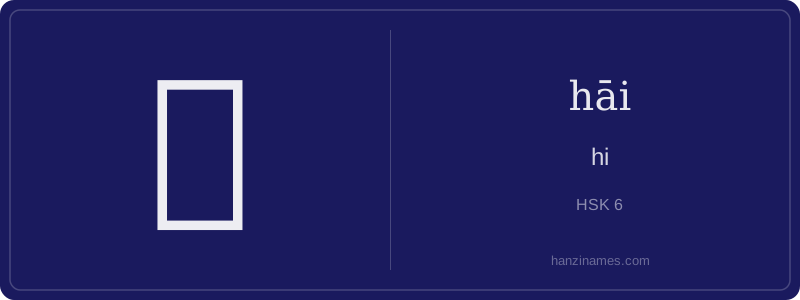
嗨 entered modern written Chinese in the late 20th century as a phonetic transcription of English 'hi' or 'hey', especially in internet chat, subtitles, advertisements, and youth-oriented media. It’s documented in the 2005 edition of the Contemporary Chinese Dictionary (第6版) as a loanword interjection. You’ll see it in pop lyrics, WeChat greetings, and bilingual signage — never in formal documents or classical texts.
The character isn’t ancient: it has no oracle bone or seal script form. Its structure combines 口 (mouth, indicating speech) and 海 (hǎi, 'sea') used solely for sound — a classic example of a phonetic-semantic compound where the ‘semantic’ part (口) is relevant, but the ‘phonetic’ part (海) contributes only pronunciation (hāi ≈ hǎi, with tone shift). No maritime meaning intended!
Hi! Let’s learn 嗨 (hāi) — a fun, expressive character that’s more about feeling than grammar. Though it looks like a formal Chinese character with 13 strokes and the 口 (mouth) radical, it’s actually a phonetic loan: borrowed to write the English interjection 'hi' or 'hey' in informal speech and writing. Don’t confuse it with classical Chinese — it’s modern, colloquial, and full of personality!
While dictionaries list 'oh alas' as a rare literary meaning, that usage is nearly obsolete today. In real life, 嗨 almost always functions as a casual greeting or attention-getter — like shouting 'Hey!' across a noisy room or typing '嗨!' in a WeChat message. Its tone is friendly, slightly playful, and very contemporary.
As an HSK Level 6 character, 嗨 appears not because it’s essential for daily survival, but because advanced learners need to recognize how Chinese absorbs global sounds. It reflects language evolution in action: the mouth radical (口) signals speech, while the right side (海 hǎi, 'sea') is purely phonetic — no sea involved! Think of it as Chinese ‘spelling out’ an English sound using familiar characters.
Example Sentences
Common Compounds
Similar Characters — Don't Mix These Up
Your First Step into Chinese Culture: Get a Chinese Name
Every journey into Chinese begins with a name. Use our free Chinese name generator to create a meaningful, personalized Chinese name that fits you perfectly.
Get My Chinese Name →