呕
Character Story & Explanation
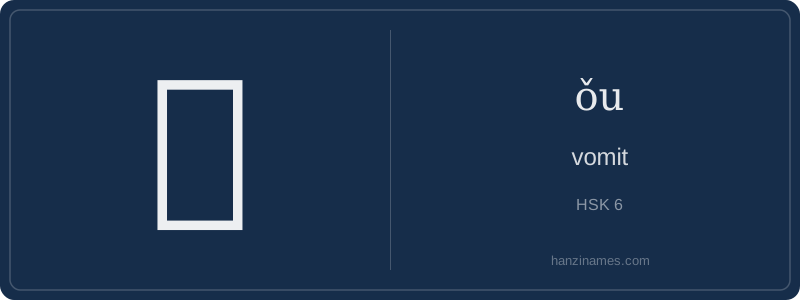
In daily life, 呕 appears most frequently in health contexts: medical reports (‘呕血’ — hematemesis), travel advisories (‘晕船导致恶心呕吐’ — motion sickness causing nausea and vomiting), and over-the-counter drug packaging (e.g., ‘止呕药’ — antiemetic). It features in the classical idiom ‘呕心沥血’ (ǒu xīn lì xuè), documented since the Tang dynasty, meaning ‘to exert oneself to the utmost’—literally ‘vomit heart and drip blood’, reflecting extreme effort.
The character is not pictographic; its form emerged during the clerical script (Lìshū) era. 口 is the semantic indicator (mouth-related action), while 区 serves purely as a phonetic loan—no visual depiction of vomiting exists. Today, Chinese speakers most commonly encounter it in hospital triage forms or parenting forums discussing infant reflux—always tied to real, embodied physiology.
As an archaeologist sifting through layers of linguistic sediment, I find 呕 not in oracle bones—but in the medical manuscripts of the Han dynasty. Its earliest secure attestation appears in the Shanghan Lun (c. 200 CE), where it denotes involuntary gastric expulsion—never metaphorical or poetic. The character’s consistency across centuries suggests functional precision: it was a clinical term long before entering colloquial speech.
The radical 口 (mouth) anchors its physiological domain—no ambiguity about the orifice involved. Unlike many characters that evolved abstract meanings, 呕 resisted semantic drift for over 1,800 years. Even in Tang poetry, when used figuratively (e.g., ‘vomiting sorrow’), it retained visceral weight, signaling bodily distress rather than mere expression.
Excavating modern usage reveals how deeply this ancient clinical marker persists. In contemporary Mandarin, 呕 still triggers immediate somatic association—its phonetic component 区 (qū) contributes no meaning but stabilizes pronunciation. There’s no evidence of folk etymology or mythic origin; instead, we see pragmatic orthographic engineering: a mouth + a sound cue, optimized for clarity in diagnosis, pharmacy labels, and emergency signage.
Example Sentences
Common Compounds
Similar Characters — Don't Mix These Up
Your First Step into Chinese Culture: Get a Chinese Name
Every journey into Chinese begins with a name. Use our free Chinese name generator to create a meaningful, personalized Chinese name that fits you perfectly.
Get My Chinese Name →