嘛
Character Story & Explanation
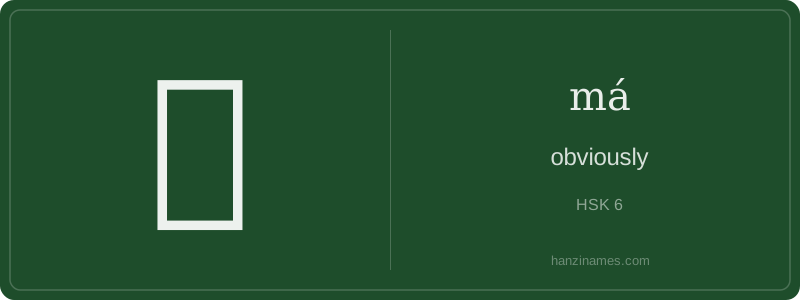
嘛 is ubiquitous in contemporary Northern Mandarin and Beijing-influenced speech, especially in dialogue-heavy contexts like sitcoms (e.g., the classic series I Love My Family) and WeChat chats. Linguists note its frequent use in concessive or explanatory clauses ('It’s fine, má — I understand') and in softening directives ('Just do it, má!'). It rarely appears in formal writing or official documents, reflecting its colloquial, interpersonal role. No classical idiom or ancient text features 嘛 as a standalone particle — it emerged robustly only in late Qing and Republican-era vernacular literature.
The character 嘛 is a phono-semantic compound: 口 (mouth, indicating speech-related function) + 麻 (má, phonetic component and semantic hint — 'hemp', historically associated with 'numbness' or 'indifference', subtly reinforcing the 'obvious-to-the-point-of-being-taken-for-granted' sense). This structure is well-documented in the Shuōwén Jiězì commentary tradition and modern character dictionaries like Xiàndài Hànyǔ Cídiǎn.
Hi students! Today we’re learning 嘛 (má), a tiny but mighty modal particle — not a verb or noun, but a tone-shaping tool that adds nuance to speech. Think of it like adding 'obviously!' or 'well, duh!' to a sentence in English — it signals shared knowledge, mild impatience, or gentle emphasis. It’s almost never used alone and always appears at the end of clauses or sentences. Don’t confuse it with question particles like 吗 (ma) — 嘛 is about obviousness, not doubt.
pronunciation matters: it’s má (second tone), not ma (neutral tone). Mispronouncing it as ma can make your sentence sound like a question or lose its emphatic flavor entirely. In spoken Mandarin, native speakers often stretch this syllable slightly — 'máaaa' — especially when expressing light exasperation or affectionate insistence ('You *know* this already, má!'). Practice listening to authentic dialogues where it’s used naturally, not just textbook examples.
Though listed at HSK Level 6, 嘛 appears frequently in informal speech, TV dramas, and social media — meaning you’ll hear it long before you master advanced grammar. Its simplicity (just 14 strokes, radical 口) belies its subtlety: mastering 嘛 means understanding *how* Chinese speakers negotiate shared assumptions. It’s less about vocabulary and more about cultural fluency — knowing when something is 'so obvious we don’t even need to explain it.'
Example Sentences
Common Compounds
Similar Characters — Don't Mix These Up
Your First Step into Chinese Culture: Get a Chinese Name
Every journey into Chinese begins with a name. Use our free Chinese name generator to create a meaningful, personalized Chinese name that fits you perfectly.
Get My Chinese Name →