嘲
Character Story & Explanation
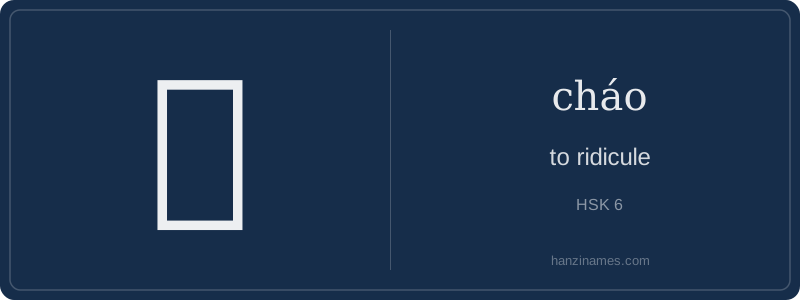
嘲 is widely used in modern Chinese media and literature to describe sharp, verbal satire—especially in political cartoons, online commentary, and satirical essays. It appears in the standard idiom 嘲笑 (cháo xiào, 'to mock/laugh at'), frequently in news reports about public reactions to scandals or policy missteps. Historically, it appears in Ming-Qing vernacular fiction like *Jin Ping Mei*, where characters use 嘲 to expose moral contradictions through biting dialogue.
The character’s form is phono-semantic: 口 (kǒu, 'mouth') as the semantic radical signals speech-related meaning, while 朝 (cháo, 'to face/toward') serves as the phonetic component—though pronunciation diverged slightly over time. No oracle bone or bronze script forms survive; its earliest attestation is in Han dynasty bamboo slips, consistently written with 口 + 朝 structure.
The character 嘲 (cháo) embodies a subtle yet potent dimension of Chinese social ethics: the boundary between playful teasing and harmful mockery. In Confucian-influenced society, speech is not neutral—it carries moral weight. To 嘲 is to wield words as instruments of social judgment, often revealing power imbalances: a superior mocking a subordinate, peers testing group belonging, or critics dismantling pretension. This reflects a worldview where language actively constructs reality—and relational harmony hinges on its mindful use.
Unlike blunt English 'ridicule', 嘲 implies performative, vocalized derision—rooted in the 口 (mouth) radical—often layered with irony or theatricality. It appears in classical poetry to critique hypocrisy (e.g., Tang dynasty satires), and in modern discourse to call out performative virtue signaling. The character thus encodes a cultural sensitivity: ridicule isn’t just unkind—it risks destabilizing *mianzi* (face) and disrupting the delicate equilibrium of mutual respect.
Crucially, 嘲 is rarely morally absolute in Chinese usage. A witty 嘲 among friends may strengthen bonds; the same tone from an authority figure can humiliate. This contextual nuance mirrors the broader Chinese emphasis on *shì* (appropriateness) over rigid rules. Mastery of 嘲 means reading intent, hierarchy, and setting—not just vocabulary. It’s a linguistic mirror reflecting how Chinese culture values relational intelligence as deeply as linguistic accuracy.
Example Sentences
Common Compounds
Similar Characters — Don't Mix These Up
Your First Step into Chinese Culture: Get a Chinese Name
Every journey into Chinese begins with a name. Use our free Chinese name generator to create a meaningful, personalized Chinese name that fits you perfectly.
Get My Chinese Name →