塌
Character Story & Explanation
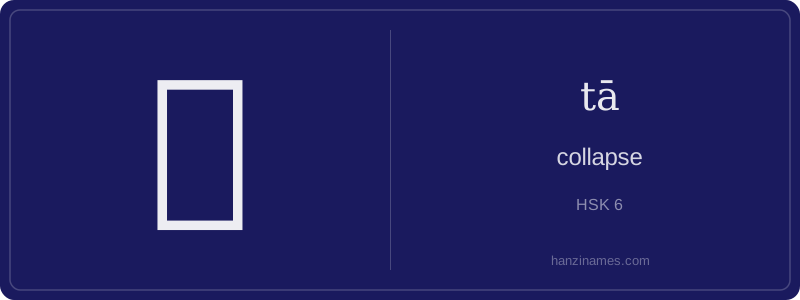
In modern Chinese, 塌 appears frequently in news reports about infrastructure failure, geological hazards, and economic crises—e.g., '楼市塌方' (housing market collapse) or '堤坝塌陷' (dam collapse). A well-documented idiom is 塌天大祸 (tā tiān dà huò), meaning 'catastrophic disaster', recorded in Ming dynasty vernacular fiction like *Jin Ping Mei*. It also features in safety regulations: China’s 2022 Emergency Management Standard explicitly uses 塌陷 for 'ground subsidence' (GB/T 37228–2022).
The character’s form has no oracle-bone or bronze script attestation. Its earliest secure appearance is in clerical script on Han bamboo slips, showing 土 + a simplified phonetic element derived from 荅 (dá). Today, Chinese speakers most commonly encounter it in weather alerts ('山体塌方' — mountain slope collapse) or construction site warnings—always tied to tangible, physics-based failure, never metaphorical 'emotional collapse' (which uses 崩 or 溃).
As an archaeologist brushing dust from a Han dynasty bamboo slip, I find 塌 etched not as a dramatic ruin—but as a quiet, structural failure: earth (土) giving way beneath weight. Its left radical 土 confirms grounding in the physical world—soil, terrain, foundations—while the right component 褐 (originally 袯, simplified to 袯→塌) hints at downward motion and loss of integrity. This isn’t mythic destruction; it’s the measurable moment when load exceeds bearing capacity.
The character first appears reliably in Eastern Han texts like the *Shuowen Jiezi* (121 CE), defined as ‘earth sinking’ (土下陷也). Unlike explosive characters like 炸 (explode), 塌 conveys inevitability—not sudden violence, but gravitational surrender. Excavations at Luoyang’s Eastern Han city walls reveal layers where clay strata slumped inward—exactly the phenomenon this character was coined to name: slow, irreversible subsidence.
Its thirteen strokes map a descent: the initial horizontal stroke of 土 anchors us, then the diagonal dot (丶) and folded strokes cascade downward—visually mirroring collapse itself. Even its phonetic component (荅, now obscured in modern form) once carried connotations of ‘answering with decline’. In imperial engineering records, 塌 appears in reports on granary foundations and terrace failures—always paired with measurements, not omens. It is language forged in pragmatism, not poetry.
Example Sentences
Common Compounds
Similar Characters — Don't Mix These Up
Your First Step into Chinese Culture: Get a Chinese Name
Every journey into Chinese begins with a name. Use our free Chinese name generator to create a meaningful, personalized Chinese name that fits you perfectly.
Get My Chinese Name →