塔
Character Story & Explanation
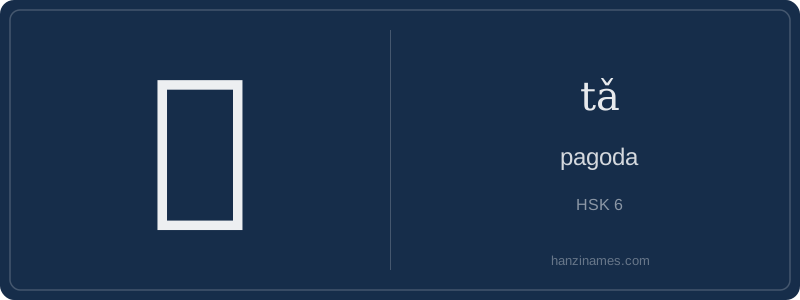
塔 entered Chinese via transliteration of the Sanskrit 'stūpa' (as 't'u-po' in early texts), first appearing in Han dynasty Buddhist translations. Historically, pagodas were built across China—like the 7th-century Giant Wild Goose Pagoda in Xi’an—to enshrine scriptures and relics. Today, 塔 appears in over 200 place names (e.g., 六和塔 in Hangzhou) and modern compounds like 信号塔 (signal tower) and 电视塔 (TV tower).
The character’s form is phono-semantic: 土 (earth, radical, indicating material/grounding) + 答 (dá, phonetic component, approximating tǎ). It is not pictographic; its structure reflects Han-era script standardization—not oracle bone origins. In daily life, Chinese people use 塔 most commonly in geographical names, infrastructure terms, and Buddhist contexts—never as a standalone verb or abstract noun.
The character 塔 (tǎ) embodies a profound convergence of Indian Buddhist architecture and Chinese cosmological sensibility. Introduced with Buddhism around the 1st century CE, the 'pagoda' was not merely a building but a vertical axis mundi—linking earth to heaven, human practice to spiritual ascent. Its layered, tiered form mirrors the Daoist and Confucian reverence for hierarchical harmony, where each level signifies a stage of cultivation or cosmic order.
Unlike Western towers built for defense or dominance, the Chinese 塔 traditionally served mnemonic, devotional, and geomantic purposes: housing sutras or relics, marking sacred geography, or correcting feng shui imbalances. Its radical 土 (earth) grounds this celestial structure in tangible reality—reminding us that transcendence begins with rootedness, not escape. This reflects the Chinese worldview: the sacred is immanent, not otherworldly.
Even today, 塔 appears in names like 雷峰塔 (Leifeng Pagoda) or 广州塔 (Canton Tower), bridging ancient symbolism and modern identity. The character thus encodes a cultural logic where vertical aspiration never severs from horizontal responsibility—where a tower rises *from* the soil, not *above* it. In this, 塔 is less a noun than a verb: an act of mindful elevation anchored in earth, history, and collective memory.
Example Sentences
Common Compounds
Similar Characters — Don't Mix These Up
Your First Step into Chinese Culture: Get a Chinese Name
Every journey into Chinese begins with a name. Use our free Chinese name generator to create a meaningful, personalized Chinese name that fits you perfectly.
Get My Chinese Name →