坠
Character Story & Explanation
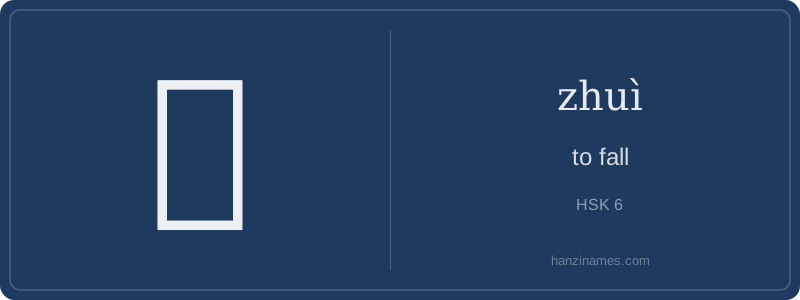
坠 is commonly used in modern Standard Mandarin for sudden, often unintended downward motion—especially in formal or written contexts: news headlines (如‘飞机坠毁’), safety warnings (‘小心坠落’), and literary descriptions. It appears in idioms like 自取灭亡 (‘self-inflicted downfall’) and the fixed phrase 坠入爱河 (‘to fall in love’), where 坠 metaphorically conveys irreversible emotional descent. Historically, it appears in Tang dynasty poetry and Ming-Qing legal documents referring to objects or people falling from height or status.
The character evolved from seal script; its current form combines 土 (radical, indicating earth-related phenomena) and 重 (zhòng, ‘heavy’—phonetic component, also semantically reinforcing weight-induced falling). Though not a pictograph, its structure visually suggests heaviness pulling downward toward the earth—mirroring real-world usage where gravity and consequence are inseparable.
The character 坠 (zhuì) embodies a quiet gravity—not just physical descent, but the moral and existential weight of decline. In classical Chinese thought, falling is rarely neutral: it signals loss of virtue (as in Confucian ‘falling from the Way’), cosmic imbalance, or the inevitability of impermanence echoed in Daoist and Buddhist texts. Its radical 土 (earth/soil) roots the action in the material world—grounding abstraction in tangible reality.
Unlike Western metaphors that often valorize ascent (‘rising above’, ‘elevated thought’), 坠 reflects a worldview where descent can be natural, inevitable, even necessary—like autumn leaves returning to soil to nourish renewal. This resonates with cyclical cosmology: falling isn’t failure, but part of qi’s rhythmic flow between heaven and earth.
HSK Level 6 placement signals its nuanced literary and formal usage—rare in casual speech but vital in essays, news reports on accidents or political ‘downfalls’, and poetic imagery. Its brevity (7 strokes) belies conceptual depth: a single character holds physics, ethics, and ecology in tension, revealing how Chinese language compresses worldview into stroke and structure.
Example Sentences
Common Compounds
Similar Characters — Don't Mix These Up
Your First Step into Chinese Culture: Get a Chinese Name
Every journey into Chinese begins with a name. Use our free Chinese name generator to create a meaningful, personalized Chinese name that fits you perfectly.
Get My Chinese Name →