墟
Character Story & Explanation
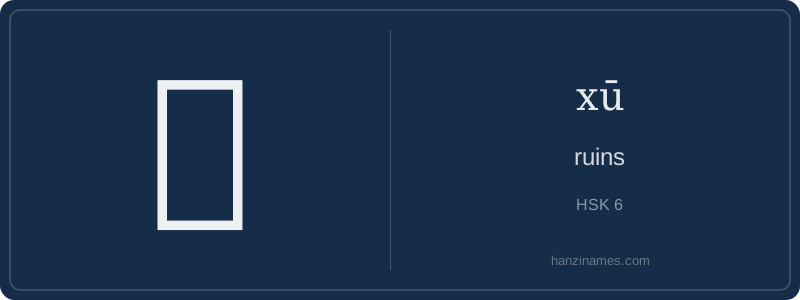
In modern Chinese, 墟 most commonly appears in place names (e.g., 深圳墟 Shēnzhèn Xū, now part of Shenzhen city—a historic market town) and literary/historical contexts. It features in the idiom 断壁残垣,一片废墟 (duàn bì cán yuán, yī piàn fèi xū)—‘broken walls, crumbling eaves, a landscape of ruins’—used in news reports about earthquakes or wartime destruction. Official documents from China’s State Administration of Cultural Heritage use 墟 to designate archaeological sites like 二里头遗址 (Èrlǐtóu Yízhǐ), where ‘遗址’ (yízhǐ) means ‘ruins site’, not generic ‘remains’.
The character’s earliest attested form appears in seal script (c. 3rd century BCE), combining 土 and 虛. It was never a pictograph of a specific ruin, but a logical compound: ‘earth’ + ‘emptiness’ → land stripped of function. Today, Chinese speakers use 墟 in heritage education, museum signage, and disaster reporting—always connoting deliberate, historically layered abandonment, not casual litter or decay.
As a detective tracing 墟 (xū), I begin at the scene: its radical 土 (earth/soil) immediately signals grounding in the physical world—this isn’t abstract decay, but land transformed by time and abandonment. The right side 虛 (xū, ‘emptiness’) is not decorative; it’s phonetic *and* semantic, reinforcing the core idea of hollowed-out space where life once thrived. Together, they form a compound ideograph: earth + emptiness = the material residue of vanished human presence.
Historically, 墟 wasn’t just rubble—it named specific places: seasonal rural markets held on open ground (e.g., ‘five-day market’ 五墟), later evolving to mean abandoned settlements after dynastic collapse or migration. In Tang and Song texts, 墟 appears in poetry mourning fallen capitals—Du Fu’s lines evoke ‘the imperial capital reduced to grassy ruins’ (宫阙尽为墟), where 墟 carries both topographical and emotional weight: silence made visible.
The character’s 14 strokes follow strict order: 土 (3 strokes) anchors the left, then 虛 unfolds with precision—horizontal, vertical, dot, hook, etc.—mirroring how ruins settle gradually, layer by layer. Its HSK 6 status reflects not rarity, but nuance: learners must grasp its dual register—literal (crumbling walls) and literary (ephemeral human endeavor). Misreading it as merely ‘waste’ misses its quiet dignity: 墟 is what remains *after* meaning departs, yet still holds memory in soil and stone.
Example Sentences
Common Compounds
Similar Characters — Don't Mix These Up
Your First Step into Chinese Culture: Get a Chinese Name
Every journey into Chinese begins with a name. Use our free Chinese name generator to create a meaningful, personalized Chinese name that fits you perfectly.
Get My Chinese Name →